
Wellness • 31/5/2026
Back Pain From Sitting: The Office Worker's Fix
Lower back pain, upper back stiffness, neck tension — most of it traces to one cause: too much sitting. The 5-minute hourly fix, the 15-minute end-of-day routine, and the weekly strength work that resolves chronic back pain in 8–12 weeks.
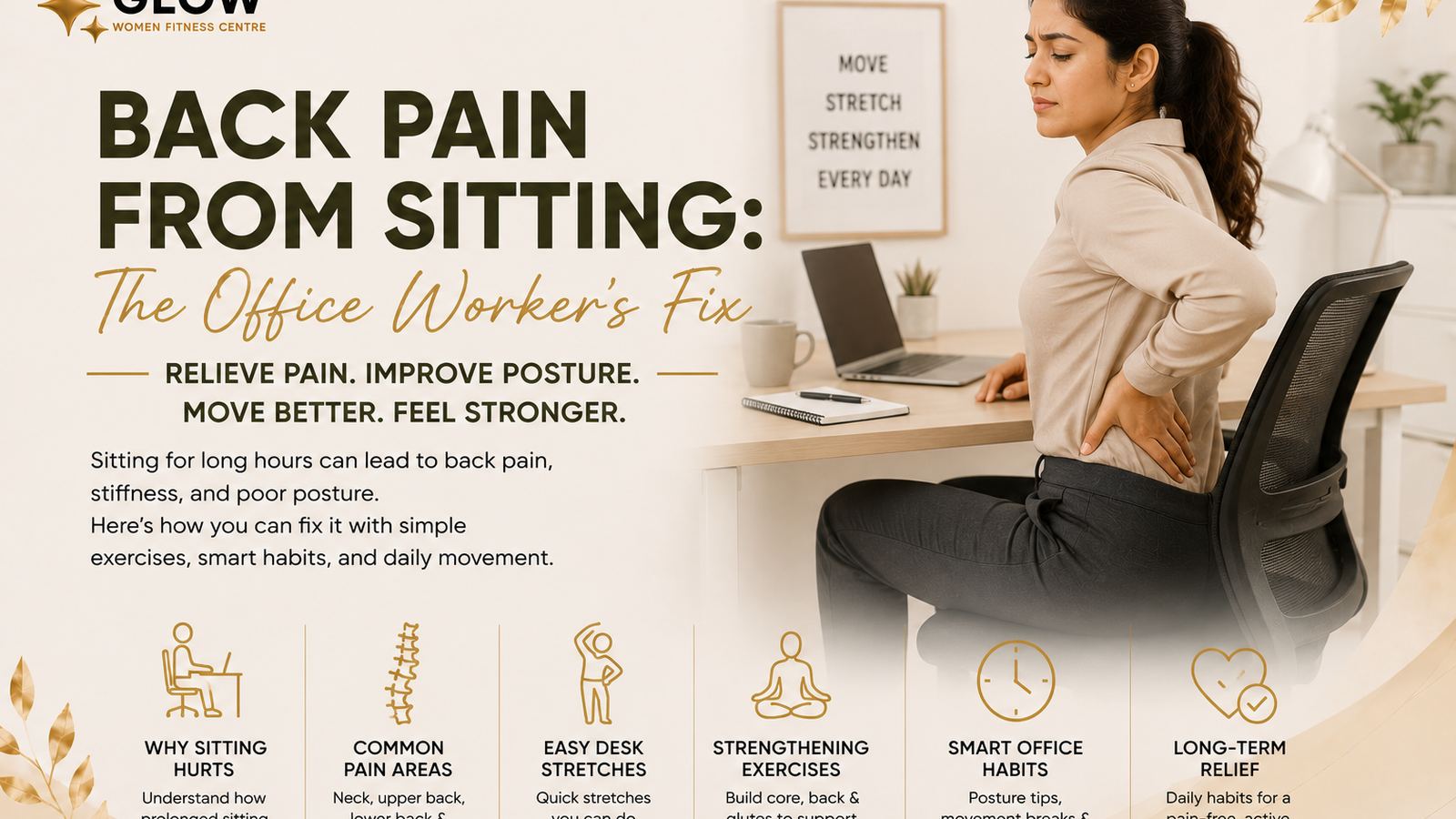
If your back hurts and you sit for 6+ hours a day at work, the cause is almost always your chair — not a structural problem with your back. The structural problem developed because of the chair, and it responds to specific, simple interventions.
Here’s the why and the protocol.
The 3 sitting-driven back patterns
Most women’s “back pain” is one of three distinct patterns:
1. Lower back pain (the most common)
What it feels like: Dull ache or stiffness across the lower back, often worse at end of day, sometimes after waking up. Bends forward feel uncomfortable; standing up after long sitting needs a few seconds.
The mechanism: Hip flexors shorten from chronic sitting → pull your pelvis forward → exaggerate the lumbar curve → muscles spasm to hold posture → pain.
Compounded by: Weak glutes (chronically sat-upon muscles forget how to fire), weak core, tight hamstrings.
2. Upper back / between-the-shoulder-blades pain
What it feels like: Burning, tightness, or a “knot” between the shoulder blades. Often worse during long computer sessions. Sometimes radiates up into the neck.
The mechanism: Shoulders roll forward from screen + phone + steering wheel posture → upper back muscles overstretched + chronically pulled → become weak + painful → the front (chest) muscles shorten and contribute.
3. Neck tension and headaches
What it feels like: Tight base of the skull, neck stiffness, tension headaches starting from the base of the neck and creeping up.
The mechanism: Head forward of shoulders (the “phone neck” / “screen neck” position) puts 4–5× the normal load on neck muscles. Sustained for years, they fatigue and refer pain.
Most desk-bound women have a combination of all three.
What chronic sitting does to women specifically
A women-specific note: the wider Q-angle (pelvis to knee) plus typically less back/glute musculature means women’s bodies are slightly more vulnerable to the sitting-induced postural issues than men’s. The fix is therefore even more important.
The 5-minute hourly reset (highest leverage)
The single most useful intervention for back pain in desk workers: interrupt the sitting every 50–60 minutes. The research is clear — frequent short breaks beat any single after-work workout for offsetting sitting damage.
A simple reset (set a phone alarm):
- Stand up. Walk to the kitchen, the printer, the balcony — anywhere away from the chair.
- 10 deep squats (bodyweight, full range).
- Doorway pec stretch — 30 seconds (arms framing the doorway, lean forward; opens the chest).
- Wall slides — 10 reps (back against wall, arms in goal-post, slide up and down).
- Neck rolls — 5 slow circles each direction.
90 seconds to 3 minutes, depending. Eight repeats across a 9-hour workday = ~15 minutes of postural reset built in.
If you do nothing else from this post, do this.
The 15-minute end-of-day routine
Once a day, before sitting on the couch for the evening. Targets exactly what office work damages:
| Exercise | Duration |
|---|---|
| Cat-cow | 1 minute (resets spine) |
| Low lunge hip flexor stretch | 60 sec each side |
| Glute bridges | 3 × 12 (wakes up dormant glutes) |
| Cobra pose | 30 sec × 3 (reverses forward curl) |
| Doorway pec stretch | 30 sec each arm |
| Wall slides | 3 × 10 |
| Standing forward fold | 60 sec (hamstrings + back release) |
| 30 deep squats | slow + controlled |
15 minutes. Done in your work clothes. Skip showers — this isn’t a workout, it’s posture maintenance.
Within 2–3 weeks of consistent practice, most women report meaningful back-pain reduction.
The strength work that fixes back pain long-term
Mobility work (above) is the daily maintenance. The actual long-term fix is strengthening the muscles that should be supporting your spine and posture:
3 strength sessions a week — what to include
Posterior chain (the back of you):
- Glute bridges → progress to single-leg
- Romanian deadlifts (RDLs) with light dumbbells
- Reverse flys (band or light dumbbells)
- Bird-dogs
- Superman
Core (deeper than just abs):
- Dead-bugs
- Bird-dogs (also above)
- Side planks (knees down OK)
- Pallof press (with band, if available)
Upper back:
- Dumbbell rows
- Face pulls (with band)
- Band pull-aparts
What you’ll notice: these are not crunches. Sit-ups and crunches do not fix back pain; they often make it worse by compressing the spine.
The muscles your back needs are the ones above. Strengthen them 3× a week and the back pain often resolves entirely within 8–12 weeks.
Posture fixes you can make today (0 minutes)
1. Screen at eye level, not lower. Use a laptop stand + external keyboard. Top of screen should be roughly at eye level when you sit up straight.
2. Feet flat, knees at 90°. If feet dangle, use a footrest. If knees are above hips, your chair is too low.
3. Phone at face level, not lap level. The “phone neck” posture — chin tucked, looking down — is responsible for a meaningful chunk of women’s neck pain.
4. Standing desk option for at least 2 hours/day if possible. Alternating sitting and standing every 30–60 minutes is optimal.
5. Stand for phone calls. Most working women can move 20–30% more of their day with no extra time.
When to see a doctor / physio
Not all back pain is sitting damage. See a doctor for:
- Pain that radiates down a leg (sciatica — possible disc issue)
- Numbness, tingling, or weakness in legs or arms
- Pain after a fall or injury (rule out fracture)
- Pain that wakes you at night (red flag)
- Loss of bladder or bowel control (urgent — cauda equina)
- Pain unchanged after 4 weeks of consistent mobility + strength work
- History of cancer + new persistent back pain
A physiotherapist is the right first port of call for chronic non-acute back pain. One assessment + a customised program is often dramatically effective. Avoid jumping straight to scans, painkillers, or surgery — most office-worker back pain doesn’t need them.
Specific situations
Back pain in pregnancy
Bump shifts your centre of gravity forward, exaggerating the lumbar curve and overworking lower-back muscles. Cat-cow, pelvic tilts, hip-opener stretches, and wide-stance squats are the daily protocol. See our Pre-Natal Fitness program.
Postpartum back pain
Very common in months 1–6. Weak pelvic floor + weak core + carrying baby asymmetrically all contribute. See our Postpartum Readiness tool for a phased return.
PCOS / perimenopause back pain
Hormonal shifts contribute. Combined with the desk-worker pattern, often worse. The same strength + mobility approach works; just expect the timeline to be slower (3–6 months for significant change).
Back pain after a long break from exercise
The chronic-sitting effects compound over years of inactivity. Start with the mobility routine before any strength work. See our post on returning to fitness after a long break (when published).
What we recommend at Glow
Our Online Everyday Glow classes include posterior-chain strength (glutes, back, core) on rotation throughout the week — the same work that fixes back pain. Plus the yoga sessions handle the mobility side.
For desk-bound women specifically, our desk-bound fitness post covers the hourly-reset and end-of-day routine in more detail.
The short version
- Office back pain = chronic sitting damage. Not a structural problem with your back.
- 3 patterns: lower back ache, upper back stiffness, neck tension. Most women have a mix.
- Highest-leverage daily fix: 5-minute hourly reset. Beats any single after-work workout.
- 15-minute end-of-day routine (cat-cow, hip flexor stretch, glute bridges, pec stretch, cobra) accelerates recovery.
- Long-term fix: 3 strength sessions/week focused on posterior chain, core, upper back.
- Crunches don’t fix back pain. They often make it worse.
- See a doctor for: radiating pain, numbness, post-fall pain, night pain, or pain unchanged after 4 weeks of work.