
Workouts • 3/6/2026
The Lower Belly Pooch: Why It's Stubborn (and What Actually Works)
The 'lower belly pooch' — the slight pouch below the navel — is the single most-asked-about body issue in women. Five distinct causes, why crunches don't help, and the actual fix for each.
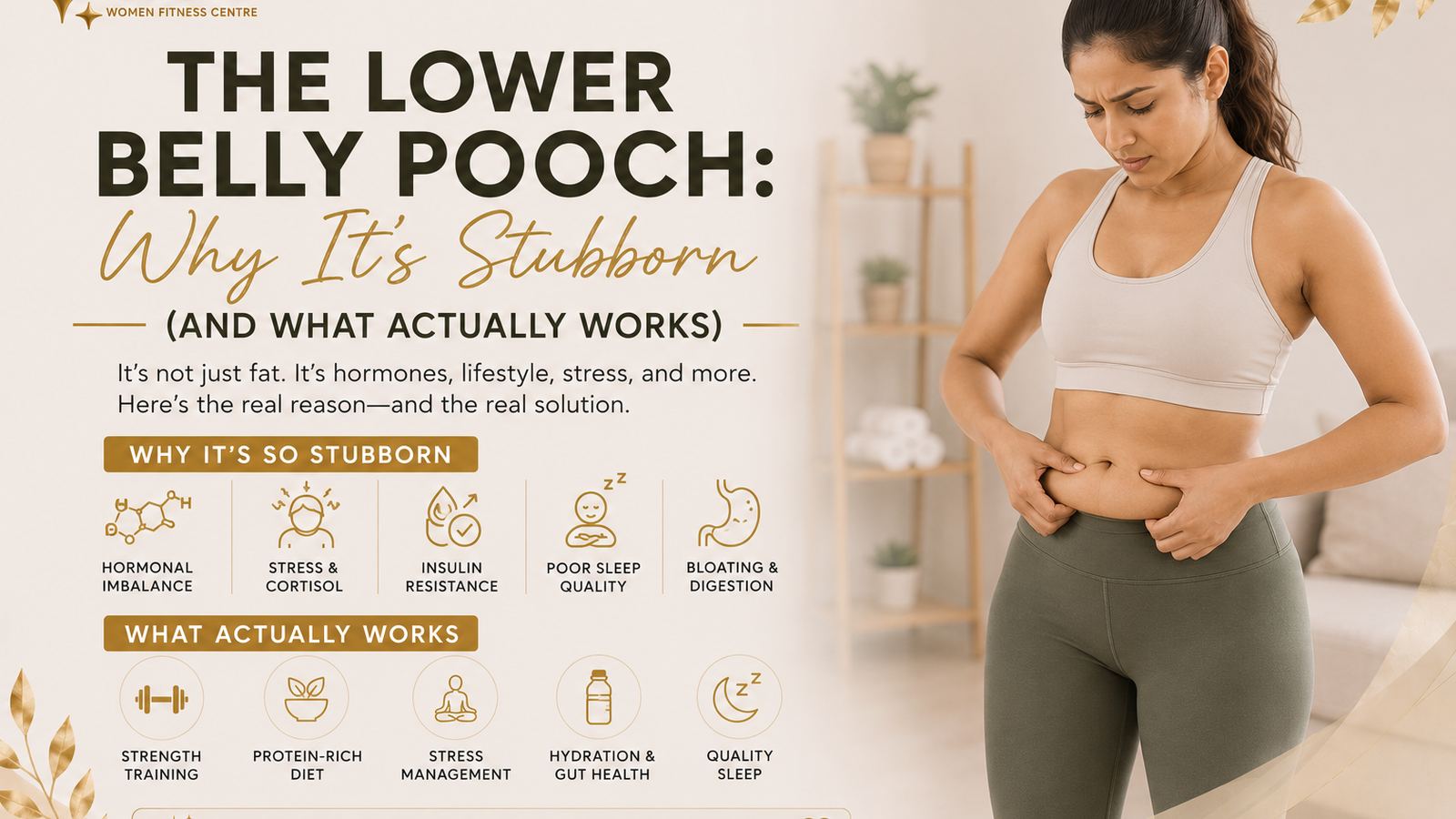
The “lower belly pooch” — the small pouch below the navel that won’t go even when the rest of you gets leaner — is the single most-asked-about body issue in women. Most fitness advice for it is wrong, because it treats it as one problem when there are actually five.
Here’s the honest version: identify which one (or which combination) you have, and fix that specifically.
The 5 causes of the lower belly pooch
Most women have a combination, weighted differently:
1. Subcutaneous fat (the most common)
What it is: a layer of pinchable fat over the lower abdomen. The same body type women have around hips and thighs — fat that sits under skin in places driven by oestrogen.
How to identify: it’s pinchable. The pooch is soft, not firm.
The fix: overall body fat reduction. You can’t spot-reduce. See our belly fat post for the full hierarchy — strength + protein + sleep + walks + modest deficit. Patience: subcutaneous fat in this area is usually the last to leave.
2. Visceral fat
What it is: deeper fat wrapped around the organs (intestines, liver). Makes the belly protrude from inside, not from a soft surface layer.
How to identify: the belly is firm, not pinchable. Waist circumference is high. You’re often the same size around your belly as your hips or larger.
The fix: insulin sensitivity work — strength training, post-meal walks, lower refined-carb intake, sleep. Visceral fat responds first and fastest to lifestyle changes. You can lose 50% of visceral fat with no change in scale weight.
3. Diastasis recti
What it is: a separation of the two halves of the rectus abdominis (the “six-pack muscles”). The midline gap allows internal organs to push through, creating a visible pouch.
How to identify: lie on your back, knees bent. Lift head slightly (chin to chest). Press 3 fingers along the midline above your navel — if you feel a gap 2+ fingers wide, or it feels deep/soft, you have diastasis recti.
60% of post-pregnancy women have some diastasis. It often shows up only as a lower belly pooch.
The fix: NOT crunches. Crunches over a diastasis often make it worse. The protocol is:
- Diaphragmatic breath work + connection breath
- Pelvic floor + transverse abdominis activation (the deep core)
- Dead-bugs, bird-dogs, side planks
- No traditional crunches, sit-ups, or planks if your belly “domes” or “cones” during them
- A pelvic-floor physio assessment is the single most useful intervention
See our Postpartum Readiness tool for the self-check and protocol.
4. Pelvic tilt (anterior pelvic tilt)
What it is: the pelvis tilting forward, exaggerating the lower-back arch, which pushes the lower abdomen out. Common in desk workers and women with tight hip flexors + weak glutes.
How to identify: stand in front of a mirror, sideways. If your lower back has a deep curve and your belly protrudes forward (even without much fat), you likely have anterior pelvic tilt. The pooch is postural, not fat.
The fix:
- Glute bridges, RDLs, hip thrusts (strengthen glutes — they pull the pelvis back into neutral)
- Hip flexor stretches (low lunge, kneeling stretch) — loosen what’s pulling the pelvis forward
- Core work that engages the deep core (dead-bugs, planks held properly)
- Skip exercises that exaggerate the arch (heavy arched-back overhead presses, etc.)
Often, this single posture fix dramatically reduces the visible “pooch” — without any fat loss.
5. Bloating + gut issues
What it is: chronic distension from gut issues, not actually fat or muscle. Often worsens throughout the day, worse in luteal week.
How to identify: belly is much flatter when you wake up; gradually expands through the day. Often gas, discomfort, or food sensitivities involved.
The fix: gut health — see our gut health post. Fix the chronic bloating first; the “pooch” may largely resolve once gut function improves.
Which one(s) is yours? A simple decision tree
Use this in front of a mirror:
- Pinch the lower belly. Can you grab a handful? → mostly subcutaneous fat.
- Lie on back, lift head, check midline gap. 2+ fingers wide gap → diastasis is contributing.
- Stand sideways, look at your posture. Deep low-back arch + protruding lower belly? → anterior pelvic tilt is contributing.
- Wake-up belly vs evening belly. Massive difference? → bloating is contributing.
- Firm, hard, won’t pinch? → likely visceral fat. Get fasting insulin tested.
Most women have 2–3 of these simultaneously, in different proportions. Treating only one (usually trying to reduce body fat) is why progress feels slow.
What does NOT work
The standard “lower belly” advice that fails:
- Endless crunches and sit-ups — don’t reduce fat, may worsen diastasis, do nothing for posture
- “Lower abs exercises” sold separately from “upper abs” — anatomically the rectus abdominis is one muscle. There’s no isolating lower vs upper.
- Waist trainers, sweat belts — restrict breathing (worsens diastasis recovery), don’t burn fat
- “Spot reduction” workouts — biologically impossible
- Detox teas — laxatives at best
- “Belly burner” creams — do nothing
The actual protocol — by cause
If subcutaneous fat is your main issue
- 3 strength sessions/week (full body, not “ab workouts”)
- Protein 1.6–2.0 g/kg (see Indian protein guide)
- Modest 300–500 cal/day deficit
- Daily walks, especially post-meal
- 7+ hours sleep
- Be patient — the lower belly is usually the last area to lean out. 3–6 months of consistency is realistic.
If visceral fat is your main issue
- Strength training (biggest visceral fat lever)
- Post-meal walks every day
- Reduce refined carbs (rice, white bread, sugar drinks)
- Sleep + stress management (cortisol drives visceral storage)
- Get fasting insulin tested — possible insulin resistance / PCOS angle
- Faster results than subcutaneous — often visible in 8–12 weeks
If diastasis is your main issue
- See a pelvic-floor physio
- Daily diaphragmatic breath + connection breath
- Dead-bugs, bird-dogs, side planks (knees-down OK)
- Skip crunches, traditional planks, sit-ups
- Most diastases close significantly over 8–16 weeks of proper work
- See our Postpartum Readiness tool
If anterior pelvic tilt is your main issue
- Glute bridges (start at 3×15) → progress to single-leg → progress with dumbbells on hips
- Hip flexor stretch daily (low lunge, 60 sec each side)
- Strengthen deep core (dead-bugs, bird-dogs)
- Be conscious of posture standing — gentle “tuck” of the tailbone underneath
- Often visible improvement in 2–4 weeks — fastest of the five fixes
If bloating is your main issue
- See our gut health post
- Protein-led breakfast
- Slow fibre + water ramp
- Daily walks
- Identify trigger foods via elimination (not via “food sensitivity tests” — those aren’t validated)
- Address luteal-phase bloating specifically (track cycle)
A combined-cause week — what most women actually do
If you have a mix (which is most women), a realistic combined-protocol week:
| Day | What |
|---|---|
| Mon | Strength A — full body, 35 min |
| Tue | Walk 45 min + 10 min hip flexor stretch + breath work |
| Wed | Strength B — focus glute bridges + RDLs + deep core, 35 min |
| Thu | Yoga 40 min |
| Fri | Strength C — full body + deep core, 35 min |
| Sat | Walk + light cardio + 10 min mobility |
| Sun | Rest |
Across the week: addresses subcutaneous fat (strength + walks), visceral fat (strength + walks + post-meal walks), pelvic tilt (glute focus + hip flexor stretches), diastasis (deep core only, no crunches), bloating (walks + adequate protein/fibre).
Most women see visible lower-belly improvement in 8–12 weeks of this combined approach. Faster if pelvic tilt is the dominant cause; slower if subcutaneous fat is the dominant cause.
A note about cycle-related “pooch days”
In the luteal week (the 7 days before your period), most women carry an extra 1–2 kg of water and food in transit. The belly visibly expands. This is biology, not loss of progress — by day 2–3 of your period, the “pooch” deflates significantly.
Don’t make body-composition judgements during luteal week. The week after your period is the more accurate read.
What we offer at Glow
Our Online Everyday Glow program includes the deep core + glute + hip flexor work that addresses postural and structural causes alongside the strength + cardio that handles fat causes.
For a fuller breakdown of any specific cause, see the linked posts in each section above.
The short version
- The lower belly pooch isn’t one problem — it’s five potential causes: subcutaneous fat, visceral fat, diastasis recti, anterior pelvic tilt, bloating.
- Most women have 2–3 simultaneously.
- Crunches and sit-ups address none of them — and often worsen diastasis.
- The decision tree above identifies which you have.
- The fix is different for each — but the combined-cause week (strength + walks + deep core + hip flexor stretches + breath work) helps all of them.
- Don’t judge progress in luteal week.
Train with us — combined-cause protocol → · Check for diastasis →