
Workouts • 29/5/2026
Beginner Running: A Couch-to-5K Plan for Indian Women
An 8-week walk-to-run progression built for Indian women — the gear that matters, the form basics, when to switch to running, what to eat before, and how to come back if life interrupts.
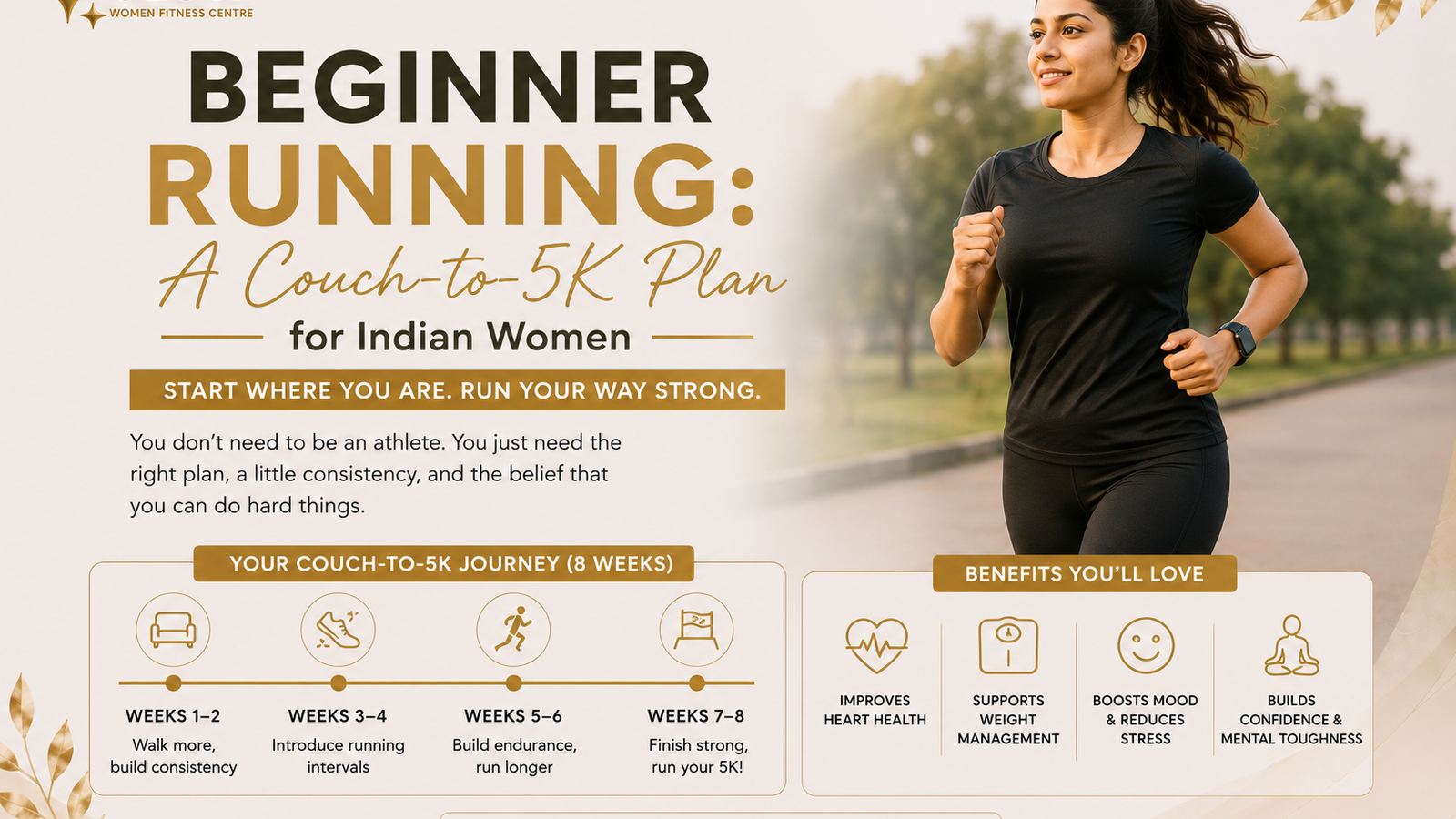
Running is the most accessible cardio in the world — and the easiest to start wrong. The “go out and run as long as you can” approach is how most beginner women injure themselves in week 2 and quit by week 4.
The Couch-to-5K approach — running interspersed with walking, progressing weekly — has 20+ years of data behind it and is the most reliable way to build to 5 km of continuous running. Here’s the Indian-women-friendly version.
Should you run at all?
Running is great for:
- Cardiovascular fitness
- Mental health (the runner’s high is real)
- Stress relief
- Weight management (combined with other things)
- The simplicity (no equipment, no class fee)
Running is less ideal for:
- Anyone with active knee, hip, or back pain (fix the underlying issues first)
- Heavy joint stress concerns (look at swimming, cycling, or rowing instead)
- Postpartum women in the first 12 weeks (see Postpartum Readiness)
- Pregnancy beyond T1 (low-impact alternatives are safer)
- Severe overweight (start with walking + strength; running comes after some weight loss)
If you’re in the “great for” group, the rest of this is for you.
Before you start: 4 things to get right
1. Shoes that fit your foot
The single most important purchase. Skip the fashion sneakers and the cheap ones from a market. A proper running shoe (Asics Gel-Cumulus, Brooks Ghost, Nike Pegasus, Saucony Triumph — all under ₹10,000) lasts about 600–800 km and prevents most foot/knee/shin issues.
Visit a running specialty store (Decathlon stores in metros have a basic gait analysis; specialty stores like Aerosport or Adidas Runners are better). Or order online with free returns and walk in them for a week.
Sizes ½ to 1 full size larger than your normal shoes — feet swell on long runs. Toe should have a thumbnail of space at the front.
2. A sports bra that actually works
Most women run in under-supportive sports bras. Bouncing strains breast tissue (causing the sagging that gets blamed on running itself), causes shoulder/upper-back pain, and is just uncomfortable.
A high-impact sports bra in your correct size, with adjustable straps, and replaced every 6–12 months as elastic wears out. ₹1,500–₹3,500 for a good one — worth every rupee.
3. Running clothes that don’t chafe
Cotton t-shirts and shorts cause chafing in places you didn’t know could chafe. Quick-dry synthetic running gear matters. Decathlon’s Kalenji line is affordable and works.
4. A safe place to run
For most Indian women, this means:
- A morning slot (less traffic, cooler, generally safer feeling)
- A familiar route — start with loops near home or a park
- Well-lit if evening / dusk
- A friend or running group if possible
Apartment-society running tracks, neighbourhood parks, and athletic stadiums are usually safer than open streets.
The form basics
Most beginner running injuries come from bad form. The 5 cues:
- Shorter strides than you think. Aim for 170+ steps per minute. Most beginners over-stride (foot lands far ahead of body) — this is the #1 cause of shin splints and knee pain.
- Land midfoot, not heel. Foot should land roughly under your body, not far ahead. A small forward lean from the ankles helps this naturally.
- Relaxed shoulders. If shoulders are creeping toward your ears, lower them, shake out the arms.
- Look forward, not down. Chin slightly tucked, eyes 5–10 metres ahead.
- Breathe in through nose AND mouth. Yes, both. The old “only breathe through nose” advice is wrong for endurance running.
The 8-week beginner plan
Three runs per week. Don’t run on consecutive days for the first 6 weeks — recovery matters more than volume at this stage.
Week 1: Build the habit
3 sessions:
- 30 minutes total: alternate 1 min running + 90 sec walking. Repeat 12 times.
The running should feel easy — conversation pace. If you can’t speak short sentences, slow down.
Week 2: Slightly longer runs
3 sessions:
- 30 minutes total: alternate 90 sec running + 2 min walking. Repeat 8–10 times.
Week 3: First continuous-ish run
3 sessions:
- 30 min: 1.5 min run + 90 sec walk, then 3 min run + 3 min walk × 2
Week 4: Building endurance
3 sessions:
- 30 min: 3 min run + 90 sec walk + 5 min run + 2 min walk + 3 min run + 90 sec walk + 5 min run
Week 5: The breakthrough week
3 sessions:
- Session 1: 5 min run + 3 min walk + 5 min run + 3 min walk + 5 min run
- Session 2: 8 min run + 5 min walk + 8 min run
- Session 3: 20 min continuous easy run (this is the breakthrough — first continuous 20 minutes)
Week 6: Longer continuous runs
3 sessions:
- Session 1: 25 min continuous
- Session 2: 25 min continuous
- Session 3: 25 min continuous
Week 7: Adding distance
3 sessions:
- Session 1: 25 min continuous
- Session 2: 28 min continuous
- Session 3: 30 min continuous
Week 8: The 5K
3 sessions:
- Session 1: 30 min continuous
- Session 2: 32 min continuous
- Session 3: 5 km continuous (most women finish in 32–40 minutes)
You’ve done it.
What to eat before a run
For runs under 45 min in the morning, most women can run on an empty stomach (or with just water + coffee). The body’s glycogen stores handle it.
For longer runs (45+ min) or evening runs after work, a small snack 30–60 min before helps:
- 1 banana
- A few dates + a handful of almonds
- 1 small idli + sambar
- A small bowl of poha
- 1 slice of toast + peanut butter
Don’t try anything new on a long run day. Stick to what your stomach knows.
What to do after a run
Within 30 minutes:
- Water (250–500 ml depending on length / heat)
- A snack with protein + carbs (banana + peanut butter, idli + sambar, dosa + chutney, eggs)
Within 60 minutes:
- A real meal — protein + carbs + vegetables
A 10-minute walk to cool down, then 5 minutes of gentle stretches (hip flexors, calves, hamstrings). Skip aggressive stretching — it doesn’t help recovery and may delay it.
Common beginner mistakes
- Going too fast on training runs. Easy runs should be easy. If you’re gasping by minute 5, slow down.
- Skipping strength training. Runners who do 2× strength sessions/week have fewer injuries and run faster than runners who don’t.
- Increasing distance more than 10% per week. The 10% rule is the consensus injury-prevention guideline.
- Running through pain. Soreness after a run is normal. Sharp or persistent pain is not — back off and address it.
- Comparing yourself to elite runners on Strava. Your pace is your pace. The 7-minute kilometre you ran is just as real as a 5-minute kilometre.
- Skipping rest days. Bodies adapt during rest, not during the run.
Cross-training while running
The runners who stay injury-free and improve longest are the ones who don’t only run. A balanced runner’s week:
- 3 runs (per the plan)
- 1–2 strength sessions (glutes, hips, core — directly support running)
- 1 yoga or mobility session
- 1 rest day
- Daily walks
The strength training, especially, is the biggest injury-prevention lever. Our Online Everyday Glow classes include the strength + mobility work that complements a beginner running practice perfectly.
Beyond the 5K
Once you’ve hit a 5K continuous, the options open up:
- Improve your 5K time (work on intervals, tempo runs)
- Build to 10K (gradually add distance — 16 weeks)
- Half marathon (much bigger commitment — 6+ months of structured training, 4 runs/week)
- Stay at 5K — there’s nothing wrong with this. 5K, 3×/week, for life, is an excellent cardio practice.
For specific situations
Running with PCOS
Running can help insulin sensitivity, but excess running (daily, long distances) raises cortisol counterproductively. Stick to 3 runs/week max, plus strength + walks.
Running postpartum
Wait at least 12 weeks postpartum (longer for C-section) and pass the return-to-running readiness checklist first. Then start with this Couch-to-5K plan — don’t try to pick up where you left off.
Running in pregnancy
If you were a regular runner pre-pregnancy and have an uncomplicated pregnancy, you can continue running through T1 and often into T2 — at lower intensity, with OB clearance. T3 is usually time to switch to walking and swimming.
Running in the Indian heat / humidity
Run early (before 7 AM in summer) or late (after 7 PM). Hydrate aggressively (electrolytes + water). On 40°C+ days, swap the run for indoor cardio (treadmill, dance class).
The short version
- Couch-to-5K — 8 weeks, 3 runs a week, run/walk intervals progressing to continuous 30 minutes.
- The 4 things to get right before you start: shoes that fit, a high-impact sports bra, non-chafe clothes, a safe route.
- Most beginner injuries come from form (over-striding) or going too fast on easy runs. Slow down.
- Strength training 2×/week alongside is the biggest injury-prevention lever.
- Most women hit a 5K in 8 weeks of consistent training.
Add strength to your running plan → · Build your weekly schedule →