Nutrition • 25/5/2026
The Indian Protein Guide for Women (Vegetarian + Non-Veg)
How much protein you actually need, the Indian foods that deliver it (with grams per serving), and the meal templates that hit your target without changing your kitchen. Vegetarian-friendly throughout.
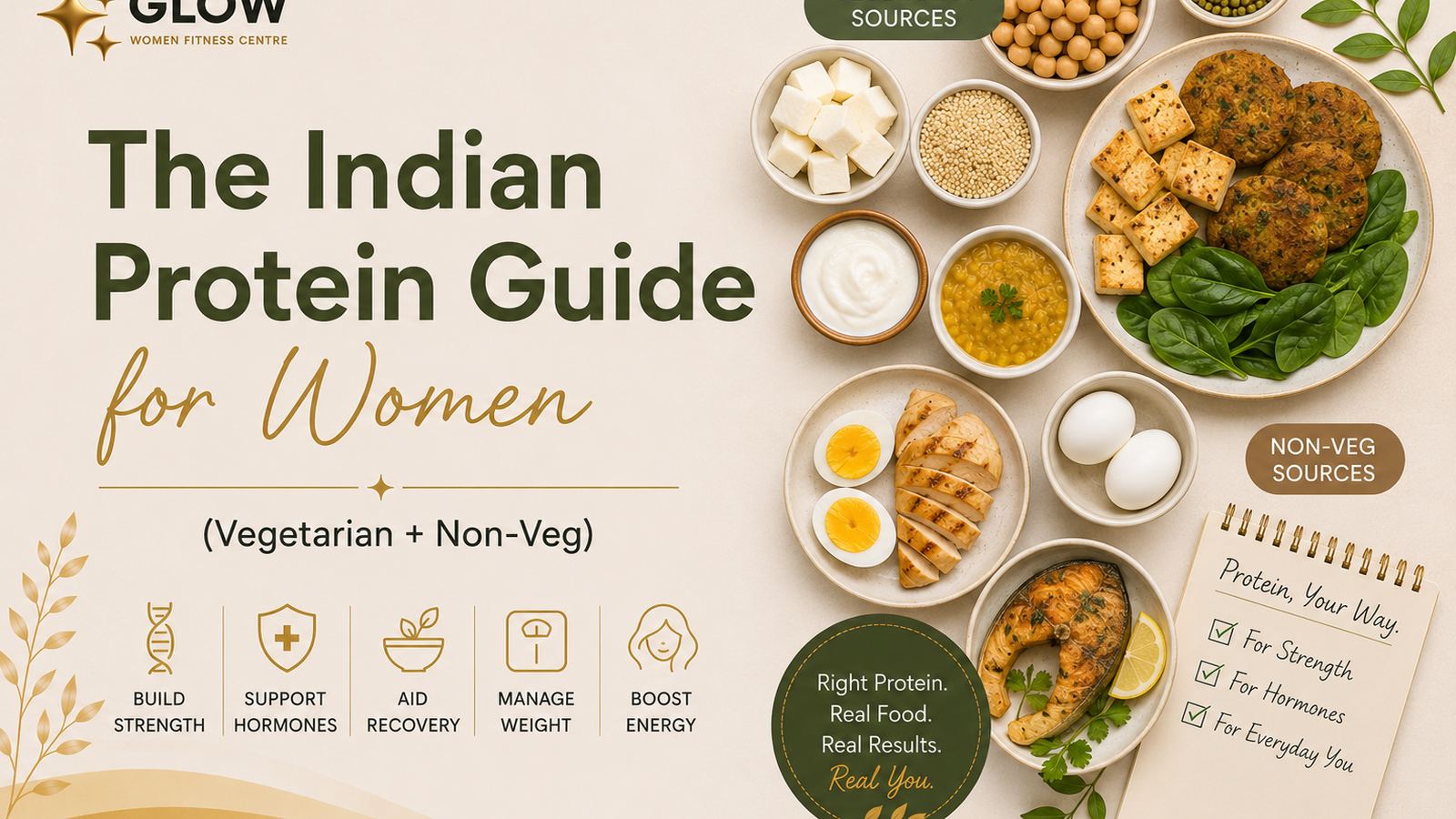
Most Indian women are eating roughly half the protein their bodies need. The standard breakfast (a couple of dosas, some chai), a vegetable-heavy lunch with one cup of dal, and a roti-sabzi dinner — together they often add up to 35–45 g of protein. The actual target for an adult Indian woman is closer to 60–100 g.
The shortfall is the single biggest reason for stalled weight loss, slow strength gains, brittle hair, low energy and the “skinny fat” body composition. The good news: fixing it doesn’t require new foods, supplements or expensive shakes. It needs the foods you already eat — in different amounts.
How much protein you need
The honest number — backed by current research, not 1990s RDA tables which under-estimated for women:
- Sedentary women: 1.0–1.2 g per kg of body weight per day
- Active / training women: 1.4–1.6 g per kg per day
- Women losing weight (in a calorie deficit): 1.6–2.0 g per kg per day
- Pregnant or breastfeeding women: 1.4–1.6 g per kg per day (extra protein matters)
- Women over 50: 1.2–1.6 g per kg per day (helps prevent age-related muscle loss)
For most Indian women, that lands between 60 g and 100 g a day. A common rule of thumb: aim for 25–30 g per meal, three meals a day — and you’ll hit your target without doing math.
(Want your exact number? The calorie calculator shows it.)
Why “I eat enough” is usually wrong
The honest math, for a typical Indian woman who weighs 60 kg and tells herself she eats “balanced” meals:
| Meal | What | Protein |
|---|---|---|
| Breakfast | 2 dosas + sambar + chutney | 8 g |
| Lunch | 2 chapatis + 1 cup mixed veg + ½ cup dal + ½ cup curd | 16 g |
| Snack | Tea + 2 biscuits | 2 g |
| Dinner | 2 chapatis + sabzi + ½ cup curd | 12 g |
| Total | ~38 g |
Target at 60 kg: 72–120 g. Actual: 38 g. The deficit is 40–80 g a day. Multiply that over months — that’s why strength gains stall, hair falls, the scale doesn’t move on a “calorie deficit”, and energy is always somewhere between average and low.
Protein per serving — the cheat sheet
The numbers that fix this. Approximate, rounded for usefulness.
Vegetarian sources
| Food | Serving | Protein (g) |
|---|---|---|
| Paneer | 100 g | 18 |
| Tofu | 100 g | 10 |
| Greek-style hung curd | 1 cup | 18 |
| Regular curd | 1 cup | 8 |
| Milk (full-fat) | 1 cup | 8 |
| Cooked moong dal | 1 cup | 14 |
| Cooked toor dal | 1 cup | 11 |
| Cooked rajma | 1 cup | 13 |
| Cooked chickpeas (chole) | 1 cup | 14 |
| Sprouted moong | 1 cup | 7 |
| Almonds | 30 g (~25 nuts) | 6 |
| Peanut chikki / peanuts | 30 g | 8 |
| Pumpkin seeds | 30 g | 9 |
| Soya chunks (cooked) | 1 cup | 27 |
| Whey protein scoop | 1 scoop (30 g) | 22 |
Non-veg sources
| Food | Serving | Protein (g) |
|---|---|---|
| 1 whole egg | 1 | 6 |
| 2 egg whites | 2 | 7 |
| Chicken breast cooked | 100 g | 30 |
| Chicken curry (boneless) | 100 g | 22 |
| Fish (rohu, surmai, salmon) | 100 g | 22–24 |
| Prawns | 100 g | 20 |
| Mutton (lean) | 100 g | 24 |
The high-leverage ones for vegetarians
If you’re vegetarian and chronically under-protein, the single highest-leverage additions are:
- Greek-style hung curd / Greek yogurt (18 g per cup vs. 8 for regular curd) — the easiest swap
- Paneer — small portions (100 g = 18 g protein) easily incorporated into wraps, sabzis, salads
- Soya chunks (27 g per cup cooked) — the highest plant protein density commonly available
- Sprouts — every meal can have a side of sprouts for cheap extra protein
- Whey or plant-protein powder in milk or smoothies once a day — the most efficient way to close the gap
Meal templates that hit 25–30 g per meal
Vegetarian breakfasts (~25 g)
Template A: 2 eggs (12 g) + 1 cup curd (8 g) + 1 medium chapati = 24 g
Template B (egg-free): 1 bowl moong dal cheela (2 chillas = ~15 g) + 1 cup curd (8 g) = 23 g
Template C (egg-free): Smoothie — 1 cup milk + 1 scoop whey/plant protein + banana = ~28 g
Template D: Paneer paratha (1, with 80 g paneer) + 1 cup curd = 22 g
Template E: Idli (3) + sambar with extra dal + 1 cup curd = 18 g (add 1 egg or paneer to hit 25)
Vegetarian lunches (~30 g)
Template A: 1 cup dal (12 g) + 1 cup chickpea curry (14 g) + chapati + sabzi = 28 g
Template B: Paneer bhurji (100 g paneer = 18 g) + 1 cup curd (8 g) + 1 chapati + salad = 26 g
Template C: Rajma chawal — 1 cup rajma (13 g) + rice + 1 cup curd (8 g) = 22 g (add 1 boiled egg = 28 g)
Template D: Mixed sprout salad with paneer + 1 chapati + dal = 30+ g
Vegetarian dinners (~25 g)
Template A: Mixed vegetable + dal (1 cup) + 2 chapatis + 1 cup curd = 24 g
Template B: Khichdi with extra moong (1.5 cups dal in the khichdi) + 1 cup curd = 26 g
Template C: Tofu stir-fry (150 g tofu = 15 g) + 1 cup brown rice + raita (1 cup curd = 8 g) = 25 g
Non-veg additions (any meal)
- 1 boiled egg adds 6 g (perfect snack)
- 100 g grilled chicken adds 30 g
- 100 g fish adds 22 g
- 100 g prawns adds 20 g
A non-veg woman aiming for 80 g protein can hit it easily with: 2 eggs at breakfast + chicken at one meal + dal/curd at remaining meals.
How to actually do this
The most useful technique: build every meal around the protein source. Don’t think “what’s for dinner” → think “what’s the protein → what goes with it.”
- Dinner is paneer bhurji → add a chapati and salad
- Lunch is fish curry → add rice and dal
- Breakfast is eggs → add a chapati or oats
This single mental shift moves women from 35 g to 80 g a day faster than any meal plan.
Common mistakes
1. Counting all foods as significant protein. A roti has 2–3 g of protein. A bowl of vegetable sabzi has 2–4 g. They count for the day’s total, but they don’t move the needle. Real protein sources contribute 10+ g per serving. Build around those.
2. Relying on milk and chai for protein. A cup of milk is 8 g. Two chais with milk add 4 g, maybe. They count. But chai is not a protein source.
3. Avoiding protein at breakfast. This is the meal where most Indian women fall furthest behind. A dosa + sambar breakfast is ~8 g. The same effort plus an egg or a cup of curd gets you to 16 g — a much better start.
4. Trusting “high protein” packaged foods. Most “high protein” biscuits, atta, and snacks have minimal extra protein (3–5 g per serving) for 2–3× the price. Whole foods win.
5. Overdoing protein powder while skipping real food. Whey shakes are a useful supplement, not a replacement. Real foods bring fibre, micronutrients, satiety. Use whey to close a gap, not as primary.
Special considerations
For weight loss
If you’re in a calorie deficit, bump protein toward the high end (1.8–2.0 g/kg). Higher protein during weight loss preserves muscle mass and controls hunger — both critical for the weight to stay off.
For PCOS
Protein is especially helpful for PCOS because it stabilises blood sugar (and therefore insulin). Eat protein first at each meal — before carbs. The order matters. (See our PCOS Self-Assessment for more.)
For pregnancy and breastfeeding
Pregnancy adds about +15–25 g of daily protein need in the second and third trimesters. Breastfeeding adds +15–20 g above maintenance. Don’t restrict during these phases; your supply and energy depend on hitting the higher target.
For women over 50
Anabolic resistance (your body’s reduced response to protein) starts around 50. The fix: same total protein, but spread across 4+ meals instead of 3, with at least 25–30 g per meal. This maximises muscle-protein synthesis at older ages.
For vegetarians worried about complete proteins
The “complete vs incomplete protein” worry is largely outdated. As long as you eat a variety of plant proteins across the day (dal, paneer, curd, soya, nuts, sprouts), you get all essential amino acids. You don’t need to combine them in every meal — only across the day.
What we recommend at Glow
For our Online Everyday Glow members, the rule is simple: 25–30 g of real protein at every meal. Coaches send Indian-context meal templates as part of onboarding.
If you want your specific target with macro splits and Indian portion examples, use the calorie calculator.
The short version
- Target: 1.4–2.0 g protein per kg per day — usually 60–100 g a day for adult Indian women.
- Most women eat half that. The shortfall is the silent reason for stalled progress.
- Build meals around the protein source, not around the carb.
- Vegetarian high-leverage: Greek-style curd, paneer, soya chunks, sprouts, whey.
- 25–30 g per meal × 3 meals = target hit without thinking.
- Higher protein matters extra during weight loss, PCOS, pregnancy, breastfeeding, and after 50.