PCOS • 23/5/2026
Online PCOS Workout Plan You Can Actually Stick To
Why PCOS needs specific training (not just any movement), the weekly plan that works, what to skip, and how live online classes finally make consistency possible. Honest, women-only.
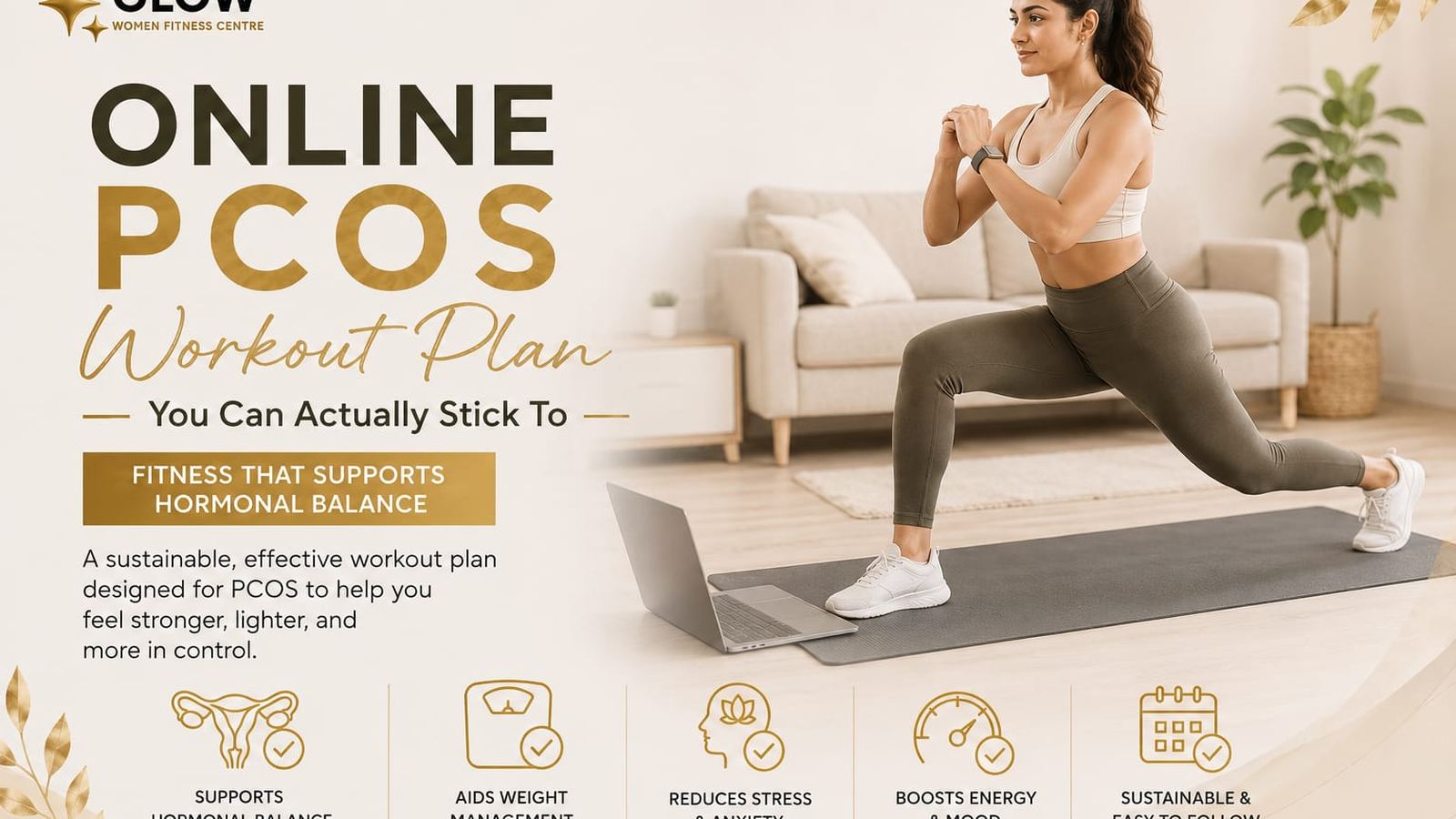
If you’ve been told to “exercise more” to manage PCOS and then watched the scale not move, the cycle not regulate and the cravings not budge — the advice was right in spirit, wrong in detail.
PCOS is not a fitness problem. It’s a hormonal and metabolic condition that responds to specific kinds of movement. The wrong kind makes it worse.
This is the right kind, structured into a weekly plan you can actually do from home, in 30–45 minutes a day.
Why PCOS responds to specific exercise
Three things drive PCOS symptoms in the majority of women:
- Insulin resistance (the metabolic engine) — up to 70% of women with PCOS have it, often even at normal weight
- Androgen excess (the visible symptoms — acne, hirsutism, scalp thinning) — usually downstream of insulin + inflammation
- Chronic low-grade inflammation
The single most powerful non-medical lever for all three is building lean muscle. Muscle is the largest glucose sink in the body — more muscle = lower fasting insulin = lower androgens over time. The chain works, reliably, in months.
The wrong kind of exercise — chronic cardio, daily HIIT, severe calorie restriction — does the opposite. It spikes cortisol, which raises insulin, which worsens androgens. This is why some women with PCOS exercise more and feel worse. The body reads it as more stress, and PCOS gets louder.
The training that works for PCOS
Strength training, 3× a week. Non-negotiable. This is the lever. Full-body sessions with the basics — squats, hip hinges, push, pull — 30–40 minutes each. Progress the weights over time. Muscle is the medicine.
Walking, daily. 20–30 minutes, especially within 60 minutes of a meal (this blunts the post-meal glucose spike — one of the most under-used PCOS interventions). A morning walk before breakfast or an evening walk after dinner does enormous work.
Yoga or pilates, 1–2× a week. Lowers cortisol — and lower cortisol means lower insulin. Specifically helpful for the “mood / energy / sleep” cluster of PCOS symptoms.
Sprint or HIIT, 1×–maybe 2× a week. A short, high-intensity session (8–10 minutes of intervals) genuinely helps insulin sensitivity. But the dose is small. Daily HIIT for PCOS is worse than 2× a week.
That’s the program. Notice what’s missing: hours of fasted cardio, daily HIIT, “shred” routines. Skip them. They make PCOS worse.
A weekly PCOS-friendly plan
A realistic week:
| Day | What | Why |
|---|---|---|
| Mon | Strength A — full body (35 min) | The biggest lever |
| Tue | Walk 30 min + 10 min mobility | Low-cortisol movement |
| Wed | Strength B — legs + core (35 min) | More muscle = lower insulin |
| Thu | Yoga 30–40 min | Cortisol down, sleep up |
| Fri | Strength C — upper + glutes (35 min) | Round out the week |
| Sat | Walk + dance / light cardio | Fun, social, not stressful |
| Sun | Rest | Recovery is when adaptation happens |
Total: about 3.5 hours of structured movement + walks. Less than you’ve been doing, probably better targeted.
What to skip (or scale back) for PCOS
- Long fasted cardio (60+ min on an empty stomach). Spikes cortisol, raises insulin paradoxically. The fitness culture sells it; the PCOS literature warns against it.
- Daily HIIT classes. Even one HIIT session a day is too much for most women with PCOS. The cortisol stack worsens the very symptoms you’re trying to fix.
- Severe calorie restriction (under 1,200 kcal). Backfires biochemically — body reads it as famine, cortisol rises, periods stop, energy crashes.
- Compulsive scale-checking. Insulin sensitivity often improves before the scale moves. Waist size, energy, sleep, cravings — these change first. Track those.
Cycle-aware programming when your cycle is irregular
PCOS often comes with cycles that are irregular, absent, or impossible to predict. Cycle-aware training is still possible — you just track symptoms instead of dates.
Watch for these signals across each 4-week period:
- Higher-energy stretch (your “follicular feel”): push strength + intensity
- Peak strong + social stretch (your “ovulation feel” — if you ovulate): heaviest lifts
- Wind-down stretch (your “luteal feel”): moderate strength + walking + yoga
- Low-energy stretch (your “menstrual feel” or PMS-like days): gentle movement only
Most women with PCOS find a 4-week rhythm even without regular periods. Our Cycle Fitness Planner gives you a guide; with PCOS, treat it as a flexible template, not a calendar.
The 4 PCOS symptom clusters
PCOS shows up differently for different women. We’ve found there are four common clusters — and which one dominates in your case affects what training emphasis matters most:
- Metabolic (weight gain, cravings, post-meal fatigue) — strength training is everything
- Androgen (acne, hair growth, scalp thinning) — strength + anti-inflammatory living
- Reproductive (cycle issues, fertility) — strength + adequate eating; avoid under-eating + over-training
- Mood / energy (fatigue, anxiety, sleep) — yoga + walks + strength all matter, not just one
The PCOS Self-Assessment walks you through identifying your dominant cluster and matches a 4-week starter protocol.
Nutrition (briefly) — because exercise alone won’t fix PCOS
Three rules that move PCOS the most:
- Protein at every meal (dal, eggs, paneer, fish, chicken, tofu — 25–30 g per meal).
- Carbs paired with fibre and protein. Eat veg + dal first, then rice/roti. Skip the empty white rice meal.
- Cut sugary drinks. Replace with chaas, jeera water, unsweetened tea. This single swap moves more weight than most workout plans do.
Inositol (myo + d-chiro, 40:1 ratio) and magnesium glycinate have decent evidence for PCOS — talk to your doctor before adding.
Sleep + stress — the underrated half
Most PCOS programs ignore this. They shouldn’t.
- 7–8 hours of sleep is medicine for PCOS. Insulin sensitivity halves with chronic sleep deprivation. If sleep is broken, prioritise fixing it before doubling your training volume.
- One daily stress-down practice (10 min of breath work, a walk in silence, journalling) drops cortisol enough to matter.
- Caffeine after 1 PM worsens both. Worth limiting.
Why live online classes work for PCOS specifically
Three reasons:
-
Consistency over heroism. PCOS rewards steady over hard. Showing up to 3 strength classes a week for 12 weeks beats a 6-day-a-week sprint for 3 weeks then collapsing. A live class with a fixed time builds that consistency in a way that recorded apps don’t.
-
A coach who knows your modifications. Some PCOS days you’ll feel awful — period (whenever it shows up), bad sleep, mood dip. A live coach scales the class accordingly. A pre-recorded library treats every day the same.
-
A women-only space for the body and mood reality of PCOS. You don’t want to be on a busy mixed gym floor on day 1 of a (finally arrived) period or in the middle of a cystic acne flare. Camera-on at home is different.
Realistic timeline for PCOS improvements
What to expect, in order:
- Week 2–4: Sleep, mood, post-meal energy improve first
- Week 4–6: Sugar cravings noticeably drop
- Week 8: Waist circumference often shrinks even when the scale hasn’t (insulin sensitivity improving)
- Week 12 (around 3 cycles): Cycle starts to regulate for many
- Month 3–6: Skin and hair shifts (hair cycles are slow — this is normal)
Stay consistent. PCOS rewards consistency on a timeline of months, not weeks.
What Online Everyday Glow offers for PCOS
Our Online Everyday Glow program runs the strength-first, low-cortisol, women-only format that PCOS responds to — six days a week, live, with a coach who knows PCOS modifications.
A dedicated Online PCOS Reversal Program is on our roadmap. Until then, Online Everyday Glow with PCOS modifications has worked well for many of our PCOS members.
Free first class. Book yours →
The short version
- PCOS needs specific exercise — strength + walks + yoga + occasional HIIT. Chronic cardio makes it worse.
- A realistic week: 3 strength sessions, daily walks, 1–2 yoga sessions. 3.5 hours total.
- Nutrition + sleep + stress matter as much as the training.
- Live online classes work especially well — consistency without the gym friction, and a coach who can adapt.
- Results land on the order of months. Stay consistent.
Take the PCOS Self-Assessment to find your dominant cluster and a 4-week starter protocol, or book a free online class → and let a coach guide you in.