Wellness • 23/5/2026
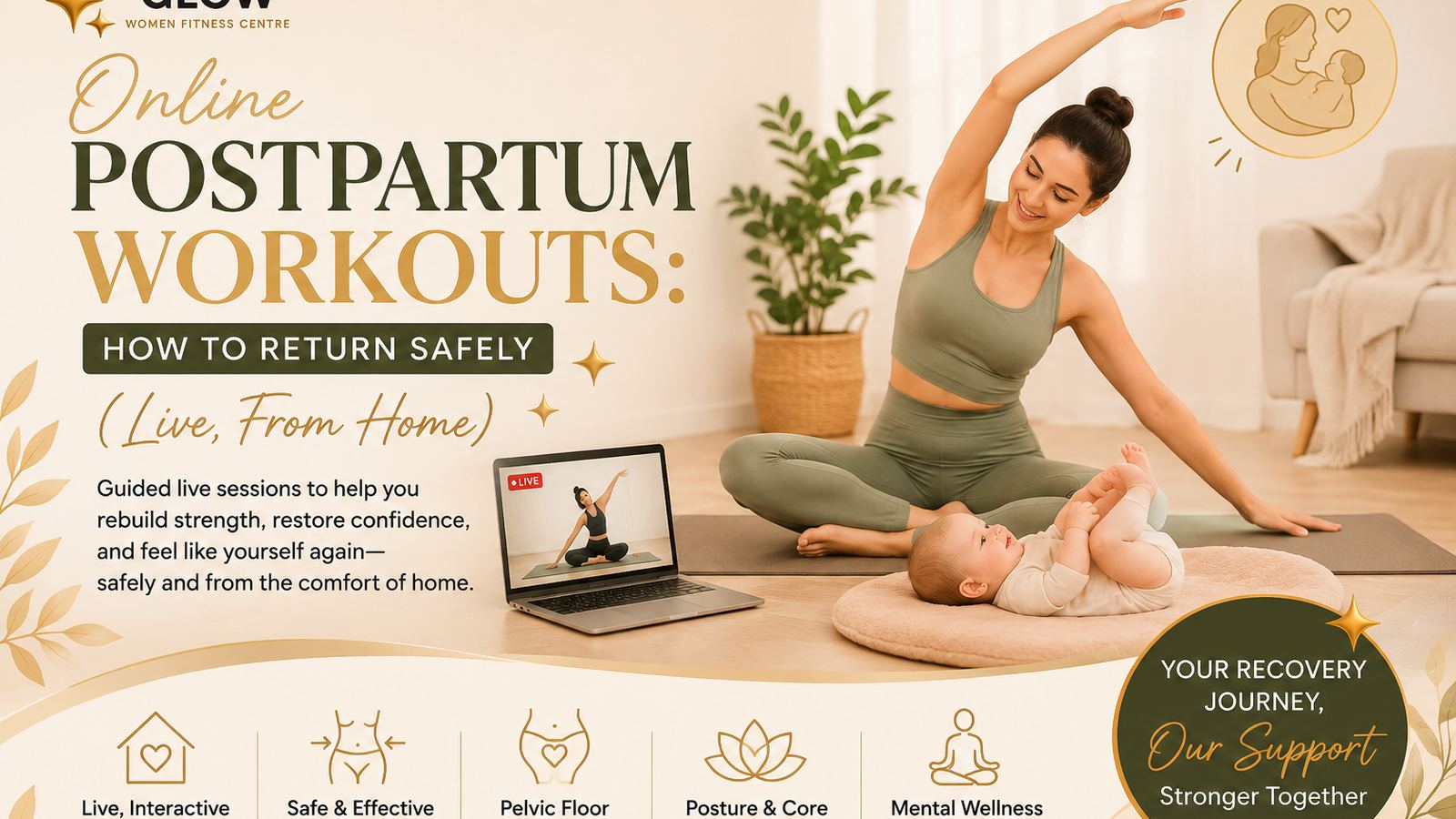
Online Postpartum Workouts: How to Return Safely (Live, From Home)
When and how to restart exercise after birth. What to do at every week, the pelvic floor work that matters, and why live online classes fit new-mom life better than any gym. Honest guidance.
The two things most postpartum fitness advice gets wrong: it’s either too aggressive (“bounce back in 8 weeks!”) or too vague (“listen to your body, you’ll know”). Neither is helpful in week three at 4 AM with cracked nipples and a body you don’t recognise.
This is the honest version. From a women-only studio that runs a live online postpartum-friendly program.
The body you bring back
You will not get your pre-pregnancy body back in 8 weeks. You may never get exactly that body back — and that’s not failure. Pregnancy reshapes your ribs, hips, pelvic floor, abdominal wall and breast tissue. The body you build after birth, with the right approach, is genuinely your body — not a comeback story.
What’s realistic:
- Week 4: Core engagement returning, back pain easing
- Week 8 (with OB clearance from week 6): Visible strength gains begin
- Week 12: Real conditioning returning, pelvic-floor symptoms (leaking, heaviness) noticeably reduced
- Week 20+: Full return to high-intensity work — running, jumping — if the pelvic floor and core have caught up
This isn’t slow. This is the timeline the human body actually needs.
Why online live classes fit new-mom life better than any gym
We say this as a studio that runs both formats and would love to see you in person — for new moms in months 1–6, online wins almost every time:
- No childcare scramble. Class runs while baby naps, or in the playpen, or in a wrap. We’ve had members nurse on camera during cool-down. It’s expected.
- No 6-week clock to leave the house. Most new moms aren’t ready for a full-clothes, full-gym morning until much later than 6 weeks. Online means you can train in stretchy clothes, hair undone, baby within reach.
- A coach who actually adapts the class to “the postnatal woman in screen 3” — modifications happen in real time. A general fitness app cannot do this.
- The other women on the screen are also new moms or post-pregnancy women. The class energy is calibrated.
Weeks 0–6: Earliest recovery — what you can do
Almost certainly not “exercise” in the way you used to think of it. But these matter, starting from week 1:
- Diaphragmatic breathing — 5 minutes, twice a day. Hand on belly, slow inhale → belly rises, long exhale → belly falls. This is the foundation of all postpartum core work.
- Gentle pelvic-floor squeezes (kegels) — 5 reps × 3 times a day, starting in bed. Yes, even in week 1.
- Short walks — building from 5 minutes around the house to 15–20 minutes outdoors as your bleeding tapers.
- Posture work — chest opens, shoulder rolls (counteracts the feeding posture you’ll be in for years).
That’s it. Anything more — crunches, jogging, lifting — risks setbacks that take 2–3× longer to undo than the time you “saved.”
Get your doctor’s clearance at the 6-week check before anything more.
Weeks 6–10: After clearance — gentle reintroduction
Now you can train. Go slow.
A solid week:
- 3 sessions of light bodyweight strength (squats to a chair, wall push-ups, glute bridges, dead-bugs) — 25 minutes each
- Daily walks, 30 min
- Pelvic-floor work daily — elevator kegels + release work (reverse kegels matter as much as squeezes)
- Postnatal yoga 2× a week — no deep twists, no traditional crunches
What to skip: running, jumping, heavy lifting, traditional crunches and planks until you’ve checked for diastasis (see below).
The diastasis check — do this before doing crunches or planks
About 60% of women have some abdominal separation (diastasis recti) in the months after birth. Doing crunches over a separation makes it worse. Here’s the 30-second self-check:
- Lie on your back, knees bent, feet flat.
- Place 3 fingers horizontally on the midline, just above your belly button.
- Lift your head slightly off the floor (chin to chest, don’t curl further).
- Press your fingers gently down — feel the gap between the two sides of your abdominal wall.
If the gap is 2+ fingers wide, or feels deep / soft, you have diastasis recti. Avoid crunches, full planks and sit-ups; see a pelvic-floor physio if possible. Most diastases heal substantially with the right exercise approach over 8–12 weeks.
Our Postpartum Readiness tool walks you through this in detail.
Weeks 10–14: Rebuild — adding light load
Now you can add light weights and longer cardio.
- Light dumbbells (3–5 kg): RDLs, rows, presses, lunges — 3×8–12 reps
- Pilates or barre 1–2× a week
- Side planks (knees down OK), bird-dogs, dead-bugs
- Walks up to 60 minutes; brisk pace OK
- Still skipping running, jumping, max-effort lifts — pelvic floor needs more time
Weeks 14–20: Return to strength
You can train most things now, with three caveats:
- Lighter than pre-pregnancy. Start at 50–60% of what you used to lift.
- Run/walk intervals only, not full runs, until you pass the return-to-running readiness check.
- Pelvic floor stays in the routine. Even when you feel strong.
A solid week:
- 3 strength sessions (progressively heavier)
- 2 cardio sessions (low-to-moderate intensity)
- 1 yoga / mobility session
- Pelvic floor + breath daily
Weeks 20+: Full return — most things on the table
You can train the way you used to, with the same body that’s done something most bodies don’t do. Many women find their strongest training era is post-baby — the focus, the priorities, the time-respect all sharpen.
The pelvic floor isn’t optional
If we could pick one thing to drill into every new mom’s head: the pelvic floor decides what you can do safely with your body for the rest of your life.
A weak or dysfunctional pelvic floor is why some women leak when they sneeze, why running feels heavy, why intercourse hurts months after birth. None of these are “normal new-mom things to live with.” All of them are addressable — but not addressed by doing crunches.
The two non-negotiables:
- Daily kegels (squeeze + release work both — releasing matters as much as contracting)
- A pelvic-floor physio visit if you have any leaking, heaviness, or pain. Even one session changes everything.
Breastfeeding and exercise
You can absolutely train while breastfeeding. Two facts to know:
- Exercise doesn’t change milk supply as long as you eat enough and hydrate. The “exercise reduces milk” claim is not supported by research.
- Feed before training (more comfortable, also empties the breast) and hydrate aggressively afterwards — exercise + breastfeeding both demand fluids.
- Calories: breastfeeding adds ~400–500 kcal/day to your needs. Do not restrict calories below maintenance while exclusively feeding. Your supply suffers, your energy crashes, and your strength gains stall.
The mental side
Postpartum mood shifts are real, and movement is one of the strongest non-medical levers. But: the pressure to be visibly recovering can make depression worse.
Baby blues — tearful, overwhelmed, mood swings in the first 2 weeks — are common and usually resolve. Postnatal depression or anxiety is different: persistent low mood past 2 weeks, hopelessness, intrusive thoughts, inability to bond. Please call your doctor, an OB, or an Indian mental-health helpline (iCall: 9152987821 · Vandrevala Foundation: 1860-2662-345). PPD is treatable, common, and not your failure.
What Online Everyday Glow offers postpartum
Our Online Everyday Glow classes include modifications for postpartum members — your coach will scale strength work appropriately, skip the contraindicated moves for diastasis, and check in on your pelvic-floor symptoms. Once you’re cleared by your OB, the live class format is the most realistic way for a new mom to stay consistent.
A dedicated Online Post-Natal program is on our roadmap — until it launches, the general Online Everyday Glow with postpartum modifications has worked well for new moms in our community.
The short version
- Weeks 0–6: breath, pelvic floor, walks. Nothing more.
- Get OB clearance at 6 weeks.
- Check for diastasis recti before doing crunches or planks.
- Pelvic floor is a daily habit, not optional.
- You’ll feel strong by week 12, fully back by week 20+ — if you go in this order.
- Online live classes fit new-mom life better than any gym for the first 6 months.
Start with a free trial class when you’re cleared by your doctor: book here →
Or work out where you are right now: use the Postpartum Readiness tool →