
Workouts • 22/5/2026
Online vs In-Person Gym for Indian Women: Which Is Right for You?
An honest side-by-side from a women-only studio that runs both. Cost, time, results, community — and which one actually fits your life.
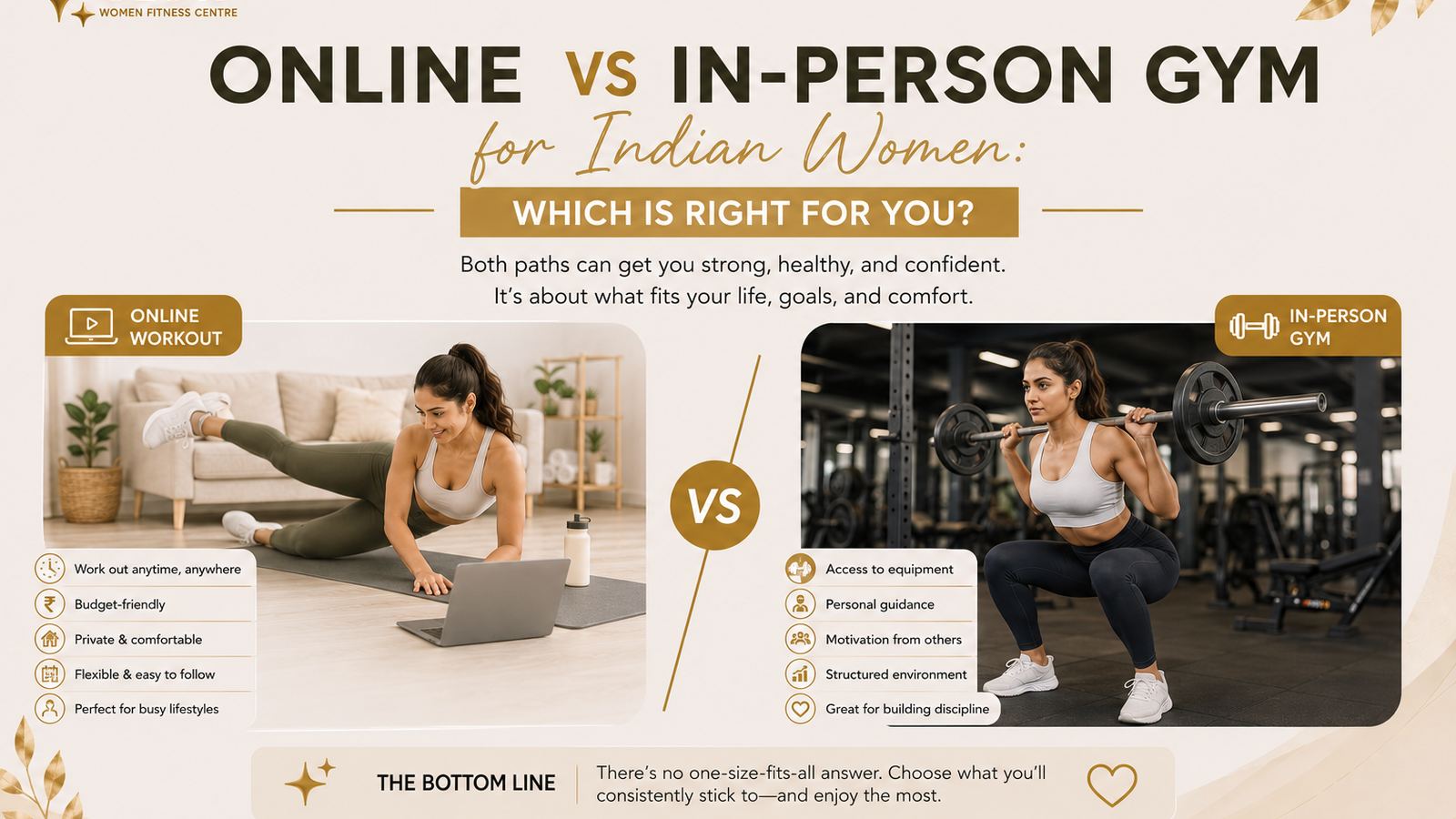
If you’re an Indian woman trying to decide between an in-person gym and a live online program, you’ve probably already noticed: the marketing for both is loud, and the honest comparison is hard to find.
We run both formats — a physical women-only studio in Tiruchengode and a live online program for women across India. Here’s the straight comparison, including the parts neither side likes to talk about.
The fast answer
If you live within a 20-minute drive of a women-friendly gym and you genuinely enjoy the gym environment, go in-person. The community and equipment access are real advantages.
If you live anywhere else, work irregular hours, have young kids, are post-pregnancy, or have ever felt out of place at a mainstream gym — online live classes will almost always serve you better than the alternatives available locally.
Most Indian women are in the second category.
What in-person gyms get right
A real coach, in person, watching you lift heavy with hands-on form correction is hard to replicate. Equipment access (full racks, machines, cables) matters once you’ve outgrown bodyweight + dumbbells. The community of women you train with regularly becomes a small, real friendship circle. And the act of leaving home, getting dressed for training, and walking into a dedicated space is a psychological signal — for many women, it’s the difference between training and not training.
What in-person gyms get wrong (and why so many women never go back)
Most mid-city Indian gyms aren’t built for women. The complaints are predictable and consistent:
- Mixed-gender floor space with very few other women, so you stand out, get watched, and end up training in the corner with the easy machines.
- No childcare, so moms with kids under five effectively can’t go.
- Limited women-only timings that don’t fit working schedules.
- Aircon turned off after 6 PM to save on bills (the women’s class is in the evening).
- Coaches trained for general fitness with no specific knowledge of pregnancy, post-pregnancy or PCOS modifications.
- Pricing is fine but the value depends on you actually going — and the friction often means you don’t.
Women-only studios (like ours, and a small number of others around the country) solve most of these. But a women-only studio nearby is genuinely rare for most Indian women.
What online live programs get right
The format breaks every one of those friction points:
- Zero commute. A 6 AM class starts at 5:58. Mat down by 6:00.
- No childcare scramble. Class runs while the baby naps, or with the toddler in the playpen next to you. We’ve had members nurse on camera during cool-down. It’s normal.
- Women-only by design. The whole screen, every class — coaches and members.
- Real coach feedback. The trainer is on camera, watching, calling out form cues by name. Better visibility than a busy gym floor, actually.
- More schedule flexibility. Morning + evening slots, six days a week. Miss a class? The next day’s slot is there.
- Privacy. Some women just don’t want to be on the gym floor in workout clothes. Camera-on at home is a different psychological space.
What online live programs get wrong (and how to spot the bad ones)
The honest cons:
- No heavy equipment. If your training has progressed to barbells and racks, online has a ceiling. (For most women — especially in the first 12–18 months of training — bodyweight + dumbbells + bands is plenty.)
- Self-motivation matters more at home. The friction is gone, which means showing up is on you. Live classes with the same coach and small group cut this — recorded libraries do not.
- A bad coach is harder to spot in the marketing. Before signing up, watch one full session of the actual coach you’ll get. If they’re not correcting form in real time and calling out members by name, it’s content, not coaching.
- Internet flakiness. A non-issue most days, but worth a Plan B.
The cost comparison
In-person women-only studios in Indian cities typically run ₹2,000–4,000/month (with annual plans often around ₹15,000–30,000/year, depending on city). Add commute time and fuel/auto cost — easily another ₹500–1,000/month in time-money.
Live online women’s programs land around ₹1,000–2,500/month with similar coach attention. No commute. No fuel. No childcare cost.
For most working women, online is roughly half the all-in cost of in-person — and gives you back 4–8 hours per month of commute time.
The exception: if you’d be paying for boutique 1:1 sessions or specialty programs (rehab, advanced powerlifting), in-person specialists are worth the premium.
The time math
| Format | Class | Commute | Get-ready | Total per session |
|---|---|---|---|---|
| In-person gym (10 km away) | 60 min | 50 min | 20 min | 130 min |
| Online live class | 45 min | 0 | 5 min | 50 min |
Over a 6-day-a-week year, that’s roughly 416 hours saved with online — 17 full days of your year, back. That’s the real argument for online for most women, not the cost.
A decision framework
Pick in-person if at least three of these are true:
- You live within 20 minutes of a women-friendly gym
- You enjoy the gym environment and miss it when you skip
- You’re past 18 months of consistent training and need heavier equipment
- You have flexible time and no young kids
- You’d genuinely use the social side of a physical space
Pick online live if at least three of these are true:
- The closest women-friendly gym is 30+ minutes away
- You have kids under 5 and no easy childcare
- Your work hours shift week-to-week
- You’re returning to fitness after pregnancy / surgery / a long break
- You’ve tried gyms before and bounced off the environment
- You want the early-morning slot but the gym opens at 6:30
The third option most women miss: do both
If you live in or near Tiruchengode, you can join us in person and use the online classes on days when life doesn’t fit. Same coaches, same program. The hybrid is what many of our members actually settle into — physical 3 days a week, online 2 days when commute doesn’t work.
How to test before committing
Both should let you try before paying. The right test:
- In-person: take a free trial during a normal class (not a 1:1 sales tour). Notice how the coach treats the other women, how many other women are training, the air, the lighting, the toilet condition.
- Online: take a free trial class with cameras on — see whether the coach actually corrects you or just performs the workout. Notice the class size and how it feels.
For our online program, the first class is free, no card required. Book a trial here →
The short version
In-person wins on equipment, community, and the psychological signal of “going to train.” Online wins on time, cost, schedule flexibility, women-only privacy, and accessibility for working women and moms. For most Indian women, the local women-only gym either doesn’t exist or doesn’t fit the day — and that’s the situation online was built for.
Curious if it works for you? Try a free live online class →