Workouts • 24/5/2026
Strength Training for Women: 5 Myths That Hold You Back
The bulking myth, the cardio-burns-fat myth, the lift-light-many-reps myth — debunked. What strength training actually does for women's bodies, and how to start.
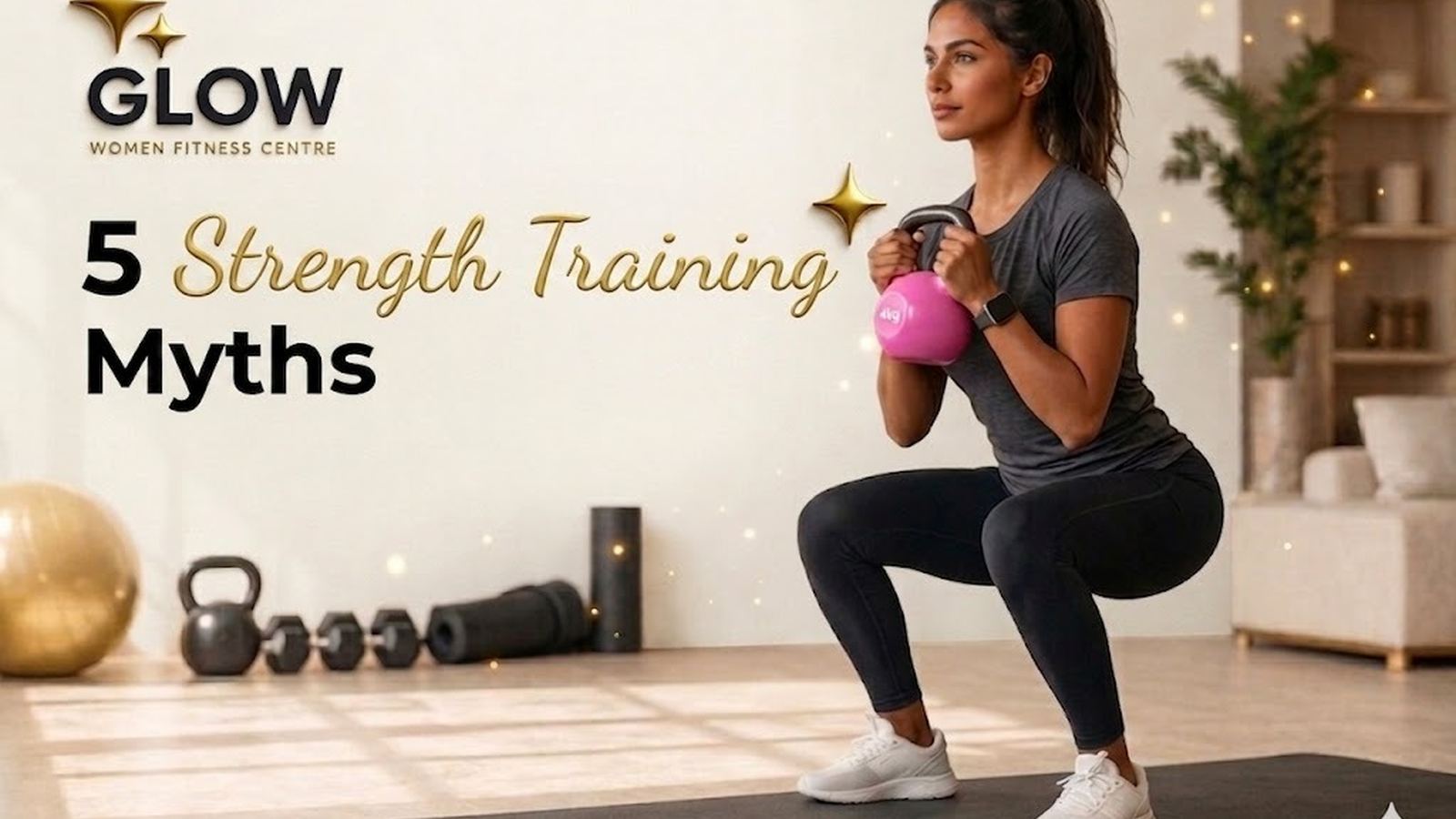
If you’ve never picked up a weight heavier than your handbag, this post is for you. If you’ve been doing 0.5 kg pink dumbbells for high reps and wondering why your body isn’t changing — definitely for you.
We coach hundreds of women through strength training at our women-only studio and in our live online classes. The same five myths come up every single week. Let’s clear them.
Myth 1: “I’ll get bulky and look like a man”
The single most common reason women avoid the weight rack. Also the most biologically wrong.
Women produce about 10–20× less testosterone than men. The hormone responsible for the muscle bulk you see in male bodybuilders is essentially missing in the average female body. The women you see with very visible bulk are either (a) elite competitive athletes training 20+ hours a week with carefully tracked nutrition and (often) performance-enhancing drugs, or (b) genetically rare outliers.
A regular woman doing strength training 3 times a week for 6 months won’t look “bulky.” She’ll look toned — which is just muscle that’s developed enough to give shape under skin, with body fat low enough that you can see it. That’s the look most women say they want.
Without strength training, you can’t get that look. Cardio doesn’t build the muscle that creates definition. Yoga doesn’t either, at the loads required. Only resistance training does.
Myth 2: “Cardio burns fat, weights build muscle — so cardio is for weight loss”
This is one of those things that’s technically half-true and practically very wrong.
Yes, a cardio session burns more calories in the session than a strength session does. But that’s not the whole picture.
Two things tilt the math toward strength training for women trying to lose fat:
1. Muscle raises your resting metabolic rate. Every kilogram of muscle you add burns roughly 50–100 extra calories per day, even when you’re sitting on your sofa. Six months of consistent strength training can add 2–4 kg of muscle for a woman — that’s an extra 100–400 calories burned every single day for the rest of your life, as long as you keep the muscle.
2. Strength training preserves muscle during a calorie deficit. When you’re losing weight, your body tries to lose muscle alongside fat (annoying, but biology). Strength training tells your body “no, hold on to this muscle.” Without strength training during weight loss, up to 30% of what you lose can be muscle — which is why so many women lose weight and look “skinny fat”, their resting metabolism drops, and the weight comes back faster.
So: cardio for heart health, strength for body composition. Not either-or. Both, with strength as the priority for body change.
Myth 3: “Higher reps with lighter weights tone — heavy weights bulk”
The myth that’s kept women on the 1 kg dumbbell shelf for decades.
The truth: “tone” is muscle definition + low enough body fat to see it. You can’t “tone” a muscle without first building it. And you build muscle by lifting weights heavy enough that the last 2–3 reps of a set are genuinely hard.
For most women, that’s far heavier than they think. A typical Indian woman who’s never lifted should be working up to:
- Squats with 8–12 kg dumbbells (or a 15–25 kg barbell) within 8–12 weeks
- Deadlifts with 15–25 kg within 12 weeks
- Push-ups from the floor within 12 weeks (start with incline push-ups)
These are not “bulky” weights. They’re functional, sensible loads that will give you the shape and strength most women say they want.
The 0.5 kg dumbbell at 25 reps is not training. It’s a fidget toy.
Myth 4: “Strength training is dangerous as you age”
The opposite is true. Strength training is the single most evidence-based intervention for healthy ageing in women.
After 30, women lose roughly 3–8% of muscle mass per decade without resistance training. By 60, this becomes a serious problem — falls, frailty, broken hips, loss of independence. Sarcopenia (age-related muscle loss) is one of the leading causes of women losing independence in their 70s and 80s.
After menopause, the rate of loss accelerates because oestrogen — which protects bone and muscle — drops sharply. Strength training is the closest thing we have to a non-drug intervention for menopausal bone density loss (osteoporosis prevention) and muscle preservation.
The danger isn’t lifting weights as you age. The danger is not lifting weights as you age.
(For specific conditions — hypertension, joint replacements, recent surgery — get medical clearance first. But “I’m 45” is a reason to start, not a reason to skip.)
Myth 5: “I need to lose weight first, then start strength training”
The most self-defeating myth, because the order is backwards.
Strength training is the highest-leverage thing you can do for fat loss, not something to add later. Starting strength training while you’re losing weight is what makes the weight loss stick — by preserving muscle, raising metabolism, and giving you a stronger, more capable body at the end, not just a smaller one.
The other version of this myth: “I’m too out of shape / weak / heavy to lift.” Wrong direction. Strength training is for the body you have today, scaled to where you are today. Squat to a chair if you can’t squat to the floor. Wall push-ups if you can’t do floor push-ups. Resistance bands before dumbbells. The body adapts.
The mistake is waiting until you’re “ready.” You’ll always feel not-ready. Start where you are.
What an actual women’s strength program looks like
Three sessions a week, 30–40 minutes each, organised around six core movements:
| Movement | Examples |
|---|---|
| Squat | Bodyweight squat → goblet squat → dumbbell squat |
| Hip hinge | Glute bridge → RDL → deadlift |
| Push | Wall push-up → incline push-up → push-up |
| Pull | Band row → dumbbell row → assisted pull-up |
| Carry / loaded carry | Farmer’s walk with dumbbells |
| Core | Dead-bug, side plank, bird-dog |
Pick one from each category, do 3 sets of 8–12 reps, and you have a complete strength session. Add weight as it gets easy. Repeat.
That’s the whole program. The complexity in fitness marketing is mostly marketing.
How to actually start
If you’ve never trained before:
Week 1–2: Bodyweight only. Two sessions a week. Master the basic patterns (squat, hinge, push, pull, plank) with good form. No dumbbells yet.
Week 3–4: Add 2 kg dumbbells. Three sessions a week. Same exercises, with the dumbbells held at chest or sides.
Week 5–8: Progress to 4–5 kg. Add a third strength movement to each session. Strength workouts become 35–40 min.
Week 9–12: Working into 5–8 kg for most exercises, 8–12 kg for squats. Strong enough to feel a real difference. Friends and family start noticing.
By month 6 you’re doing real weights, your body composition has visibly shifted, and you’ve added years to your healthy life. Strength compounds — and it compounds faster than almost any other training.
How to do this consistently
The hardest part isn’t the lifting. It’s showing up to lift consistently.
The two formats that work best for most women:
- A women-only studio with a real coach — if there’s one nearby that fits your day
- Live online classes with a coach — for everyone else
The format that doesn’t work: a random YouTube workout you’ll do twice and abandon. The format that really doesn’t work: a video library you’ll log into once.
Our Online Everyday Glow program is built around exactly this — three strength sessions a week, live, with form corrections from a coach on camera. Plus the cardio, yoga and mobility days that round out a proper week. First class is free, women-only.
The short version
- You will not get “bulky” doing strength training. Biology won’t let you.
- Strength training is the single best fat-loss lever for women — it preserves muscle and raises metabolism.
- Light weights for high reps don’t tone. Building visible muscle requires real loads.
- After 30, strength training isn’t optional — it’s the most evidence-based intervention for healthy ageing.
- Don’t wait until you’re “ready.” Start with bodyweight, today.