
Nutrition • 30/5/2026
Vitamin D Deficiency in Indian Women: The Sunlight Paradox
70–90% of urban Indian women are vitamin D deficient — despite India's sunshine. Why, the symptoms beyond bone pain, the labs and supplementation that actually work, and the food + sunlight reality check.
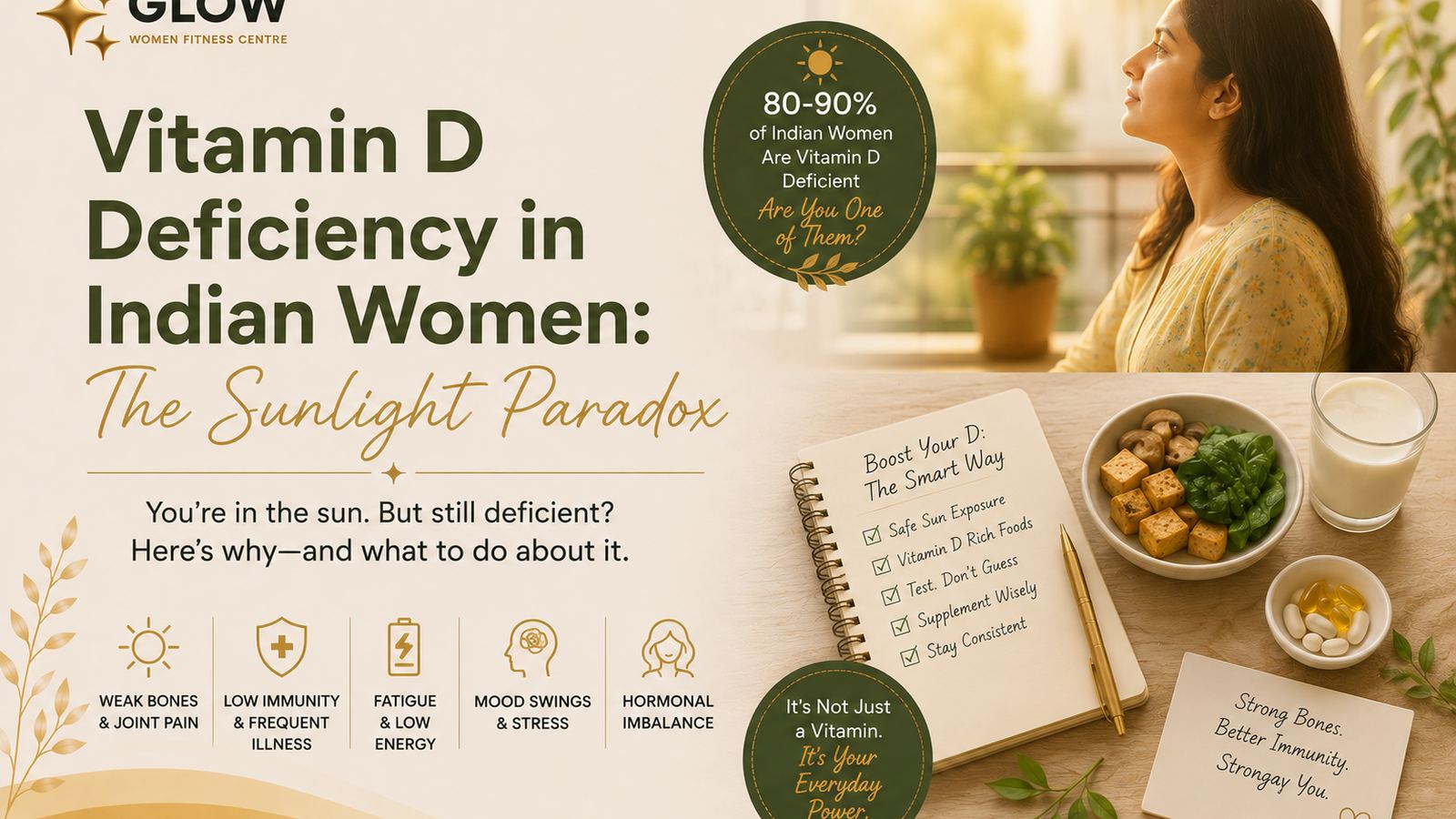
It sounds like a paradox: India gets 300+ days of sunshine a year, and yet 70–90% of urban Indian women are vitamin D deficient. The 2018 ICMR national survey put it bluntly — vitamin D deficiency is one of the most common nutritional issues in modern Indian women.
The reasons are specific. So is the fix.
Why Indian women specifically
Five factors compound:
1. Skin pigmentation. Melanin is a natural sunscreen. Darker skin produces vitamin D 3–10× more slowly than lighter skin from the same sun exposure. South Asian skin needs 30–60 minutes of midday sun for a useful dose; lighter skin needs 10–15.
2. Cultural sun avoidance. Most adult Indian women actively avoid sun — either for skin-tone reasons, for comfort, or because they’re indoors during peak sunlight hours (work, kids, kitchen). Cosmetic creams + dupattas + indoor work add up to minimal real sun exposure despite living in a sunny country.
3. Indoor work. Office hours roughly match peak sun hours. Even those who walk in the morning or evening get oblique sun — much less effective for vitamin D synthesis than midday rays.
4. Pollution. Particulate pollution in Indian metros (Delhi, Mumbai, Bangalore, Chennai) filters out a significant portion of UVB — the specific spectrum needed for vitamin D synthesis. Studies have measured 30–50% reduction in vitamin D production during high-pollution seasons in Indian cities.
5. Almost no food sources in vegetarian Indian diets. The few significant dietary sources are fatty fish (salmon, sardines), egg yolks, and fortified dairy — limited or absent in most vegetarian Indian eating patterns.
The combination: India’s sunshine is barely reaching most of its adult women.
What vitamin D actually does
It’s not just a “bone vitamin.” Vitamin D is a hormone with receptors in nearly every tissue in the body. Significant deficiency affects:
- Bone density (osteoporosis risk — by 60, low D + low oestrogen = real fracture risk)
- Mood and depression (well-evidenced link — low D is a depression risk factor)
- Muscle function and strength (fatigue, weakness, slow recovery)
- Immune function (frequent infections, slow healing)
- Insulin sensitivity (low D worsens PCOS, type 2 diabetes risk)
- Hormone production (oestrogen, progesterone, testosterone all use vitamin D in their synthesis)
- Pregnancy outcomes (gestational diabetes, pre-eclampsia, preterm birth risk all rise with low D)
- Hair loss (low D is a contributor)
A woman with low vitamin D can experience all of these as vague, separate-feeling problems. Restore the D, many of them improve together.
Symptoms of deficiency
Often dismissed because they’re non-specific:
Most common:
- Bone aches (knees, hips, lower back — not joint pain, more diffuse)
- Muscle weakness, especially in the thighs and hips
- Fatigue that doesn’t lift with rest
- Frequent colds and minor infections
- Low mood, especially in winter or rainy months
- Hair shedding
- Slow recovery from exercise
- Stress fractures (in athletes)
More severe:
- Pelvic + hip pain that’s hard to localise
- Difficulty climbing stairs (proximal muscle weakness)
- Bone tenderness when pressed
- Frequent dental issues
If you tick 3+ of these, get vitamin D tested.
The right test
Ask for 25-hydroxy vitamin D (25(OH)D), not the activated form. It’s the standard marker, available at any reasonable lab.
Interpretation (units in ng/mL — the standard Indian unit):
- < 20: Deficient
- 20–30: Insufficient
- 30–50: Adequate
- 50–80: Optimal (target range for most experts)
- > 100: Unnecessarily high
- > 150: Approaching toxicity
Many Indian women test in the 5–15 range — well into “treat” territory. Most labs report 20+ as “in range”, but functional deficiency starts well above 20.
How to fix it
The honest sequence:
Step 1: Sun exposure (limited use)
For most Indian urban women, sun alone won’t fix significant deficiency. The exposure required (30–45 minutes of midday sun on arms + legs, 3–4 days a week) is impractical and carries its own skin-cancer risks if sustained over decades.
A reasonable maintenance dose: 15–20 minutes of midday sun on arms and face, 3–4 days a week. Plus diet plus supplementation if you’re starting deficient.
Step 2: Diet
Best sources (per typical serving):
- Fatty fish (salmon, sardines, rohu): 100 g = 400–600 IU
- Egg yolks (whole egg): 1 egg = 40 IU
- Fortified milk / curd: 1 cup = 100 IU (if fortified — check the label)
- Cheese: 30 g = 7–10 IU
- Mushrooms (sun-exposed): small amount
For a vegetarian Indian woman, diet alone rarely covers daily needs. Eggs + fortified dairy + occasional fish can contribute ~200–400 IU/day. Recommended daily is 600–800 IU; deficiency repletion needs much more.
Step 3: Supplementation (almost always required)
For most Indian women with confirmed deficiency:
Repletion phase (8–12 weeks):
- 60,000 IU once a week, for 8–12 weeks (standard Indian medical practice)
- OR 5,000–10,000 IU daily for 4–8 weeks
Maintenance phase (long-term):
- 1,000–2,000 IU daily for most women
- 5,000 IU daily if BMI > 30 or chronic deficiency history
- Recheck levels every 6–12 months
Take with fat (it’s fat-soluble) — with curd, eggs, ghee meal. Take alongside vitamin K2 (M7 form, 100 mcg) and magnesium for best utilisation. Many supplements now combine D3 + K2 — check the label.
Cholecalciferol (D3) is the active form; avoid ergocalciferol (D2) — much less effective.
Don’t self-supplement above 5,000 IU/day long-term without doctor input — vitamin D toxicity is real, though rare.
The vitamin D + bone + muscle compound
For women, vitamin D works with calcium, magnesium, and protein to build bone and muscle. Just D in isolation does less than D + K2 + magnesium + adequate protein. Look at the whole picture, not just one supplement.
For specific situations
Pregnancy and breastfeeding
Vitamin D needs are higher (1,500–2,000 IU/day maintenance). Deficiency in pregnancy is linked to gestational diabetes, pre-eclampsia, and lower bone density in the baby. Most OBs now check D and supplement — push for testing if not offered.
PCOS
Low vitamin D worsens insulin resistance and androgens. Vitamin D supplementation alongside the PCOS approach often produces noticeable PCOS improvements.
Perimenopause and menopause
Combined with declining oestrogen, low D dramatically raises osteoporosis risk. Maintenance supplementation + strength training + adequate calcium is the standard protective stack.
Hair fall
Vitamin D deficiency is a contributor to diffuse hair shedding. Restoring D often slows shedding within 3–4 months (hair cycles are slow). Not a quick fix, but a real one.
Mood / depression
Vitamin D is a treatment adjunct for depression, especially seasonal patterns. Combined with exercise + sleep + therapy/medication as needed — not a standalone “antidepressant”, but a meaningful piece.
A 6-month plan for restoring vitamin D
If you’re starting deficient:
Month 1–2 (repletion):
- 60,000 IU once weekly (after doctor consultation) OR 5,000 IU daily
- Add 15–20 min of midday sun 3–4×/week
- Boost dietary sources (eggs, fish if non-veg, fortified dairy)
Month 3 (test + adjust):
- Recheck vitamin D level
- Adjust dose based on response
Month 4–6 (maintenance):
- 1,000–2,000 IU daily
- Continue sun + diet
- Annual recheck thereafter
Most women feel meaningfully better within 6–8 weeks of restoration — energy up, mood up, muscle aches reduced, immune function clearer.
Common mistakes
- Treating low D with one bottle of supplements then stopping — repletion needs 8–12 weeks; maintenance is forever-ish for most Indian women.
- Taking D without K2 + magnesium — significantly reduces effectiveness.
- Assuming sun walks “are enough” — for most urban women, they’re not, especially given pollution + sun-avoidance behaviours.
- Mixing forms — D3 (cholecalciferol) is the right form, not D2.
- Skipping the maintenance dose after repletion — levels drop back fast without ongoing intake.
What we recommend at Glow
For all our online members starting Online Everyday Glow, we suggest getting vitamin D + ferritin + B12 tested at the start. These three deficiencies are rampant in Indian women and dramatically affect how training feels and how progress accumulates.
The short version
- 70–90% of urban Indian women are vitamin D deficient — despite India’s sunshine.
- Reasons: skin pigmentation + sun avoidance + indoor work + pollution + minimal dietary sources.
- Test 25(OH)D — target 50–80 ng/mL, not just “in range”.
- Repletion: 60,000 IU/week × 8–12 weeks (with doctor input); maintenance 1,000–2,000 IU/day.
- Take with fat, K2, and magnesium for best effect.
- Affects bone, mood, muscle, immune, insulin sensitivity, hormone production — not just bones.
Train with us — supplementation works better with strength training →