
Wellness • 28/5/2026
Perimenopause Weight Gain: What's Actually Happening (and What Helps)
Why the same diet that worked at 32 stops working at 42. The hormonal shifts behind perimenopause weight gain, the specific changes in body composition, and the strength + protein + HRT-conversation that actually moves it.
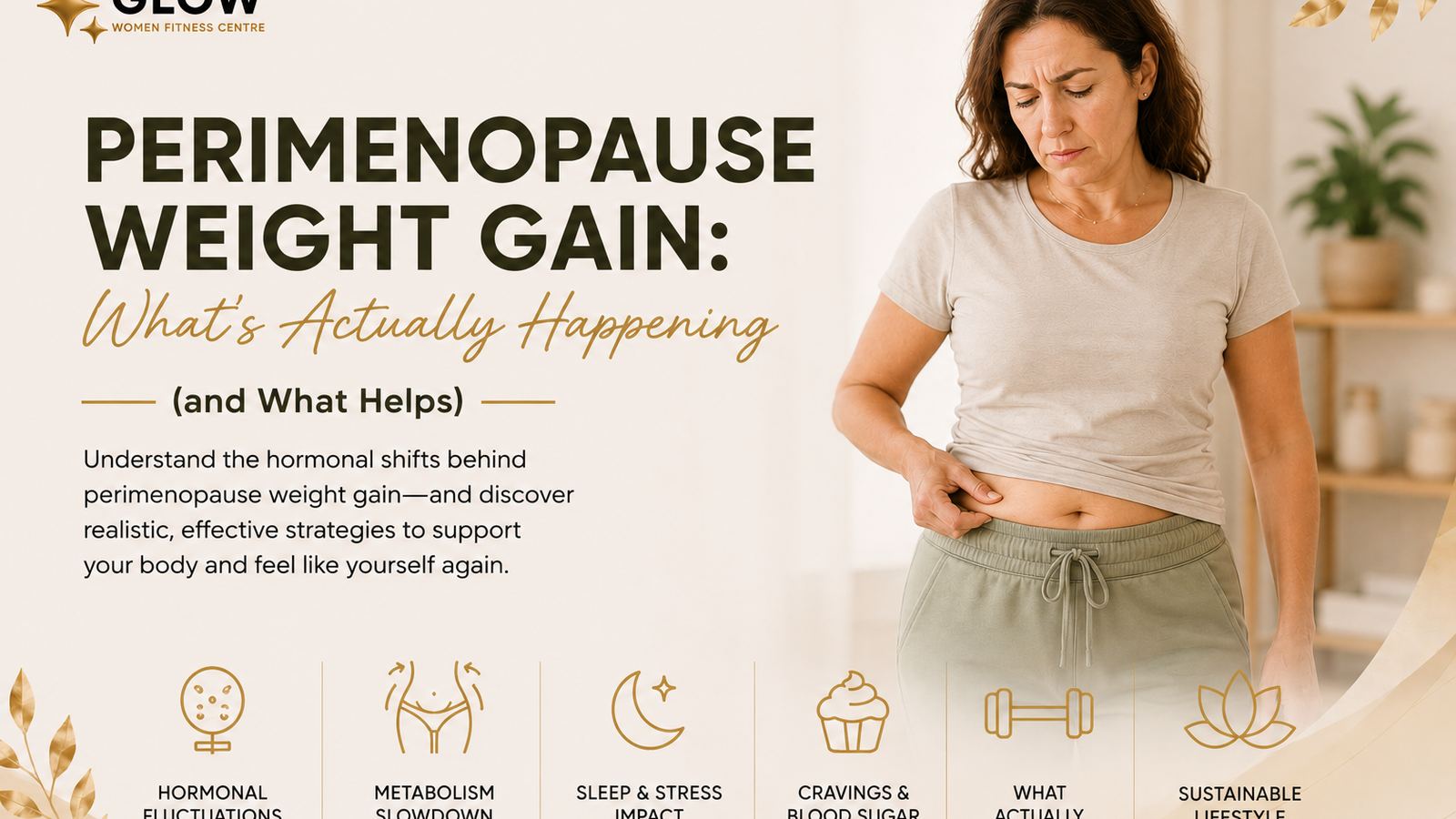
Most women, sometime in their late 30s or early 40s, experience the same disorienting shift: what used to work doesn’t anymore. Same eating, same training, same effort — and the weight slowly climbs, especially around the middle. Sleep gets worse. Mood gets harder. The body feels different.
That’s not lack of discipline. That’s perimenopause.
Here’s what’s actually happening, why standard “eat less, move more” advice often fails this phase, and what does work.
What perimenopause actually is
Perimenopause is the transition years before menopause — typically starting between 38 and 47, lasting anywhere from 2 to 10+ years. Menopause itself is the single day when you’ve gone 12 months without a period; perimenopause is the long lead-up.
Indian women on average reach menopause around age 46–49, slightly earlier than Western averages. That puts perimenopause start in the mid- to late-30s for many.
This phase is hormonally chaotic, not just declining. Oestrogen swings wildly (up then down), progesterone drops more steadily, FSH rises trying to push the ovaries to ovulate. It’s not “just” hormones running out — it’s hormones becoming unpredictable.
What weight gain in perimenopause looks like
Three changes compound, even at the same total weight:
1. Fat redistribution toward the belly. As oestrogen drops, fat storage shifts from hips/thighs (the typical female pattern) to the abdomen (the typical male pattern). A woman can stay the same weight but look noticeably thicker around the middle.
2. Muscle loss accelerates. Without intervention, women lose ~3–8% of muscle per decade after 30. Perimenopause accelerates this. Less muscle = lower metabolism = same eating leads to slow weight gain.
3. Visceral fat (the dangerous kind) rises. The fat around your organs — linked to insulin resistance, heart disease, type 2 diabetes — increases faster in perimenopause than at any earlier life stage.
The average woman gains 3–5 kg during the perimenopause transition, with most of it as belly + visceral fat. This is biology, not failure.
Why the old approach stops working
Three reasons the diet and exercise that worked at 32 stop working at 42:
1. Insulin sensitivity drops. Oestrogen helps your cells respond to insulin. As it declines, the same carb intake produces more insulin, more fat storage, more cravings. The standard carb-heavy diet that worked at 30 becomes a metabolic problem at 42.
2. Sleep gets disrupted. Hot flushes, night sweats, anxiety wake you. Even one bad week of sleep halves your insulin sensitivity, raises cortisol, increases hunger. Most women in perimenopause are operating on chronically compromised sleep.
3. Stress response amplifies. Cortisol rises with age; the buffer that protected you in your 20s and 30s is thinner now. Same stress hits harder, raises insulin further, drives more abdominal fat.
The 1,500-calorie + cardio diet that took off 5 kg at 30 can fail completely at 45. Because it ignores all three of these shifts.
What actually works
Five interventions, in order of effectiveness:
1. Strength training (the single biggest lever)
This is non-negotiable in perimenopause. Strength training:
- Preserves and rebuilds muscle (offsetting the natural decline)
- Improves insulin sensitivity (offsetting the oestrogen drop)
- Supports bone density (perimenopause is when osteoporosis risk begins)
- Lowers chronic cortisol (improves the stress response)
- Improves sleep quality (well-documented)
The protocol: 3 strength sessions a week, 35–40 minutes each. Compound movements (squats, hinges, push, pull). Heavy enough that the last 2–3 reps are hard.
Many women in perimenopause find their strength training era is now — they’re stronger at 45 with consistent training than they were at 25 without it.
2. Protein at every meal
Aim for 1.6–2.0 g protein per kg of body weight per day. Spread across 3 meals (25–35 g each).
Anabolic resistance — your body’s reduced ability to use protein efficiently — starts ramping in perimenopause. Higher protein offsets it. Skip protein and you accelerate the muscle loss.
See our Indian protein guide for women for specifics.
3. Sleep — protected fiercely
If sleep is broken (very common in perimenopause), fixing it is non-negotiable. The interventions, in order:
- Magnesium glycinate before bed (consult your doctor) — often dramatic improvement
- Cool bedroom (lower temp than usual — hot flushes hit easier in warm rooms)
- Wind-down routine (no screens 30 min before bed)
- No caffeine after 12 PM (perimenopause makes you more caffeine-sensitive)
- Talk to your doctor about HRT if sleep is severely disrupted by hot flushes / night sweats — well-evidenced, often life-changing
4. Have the HRT conversation
Hormone replacement therapy is the most under-prescribed evidence-based intervention for perimenopause and menopause. The 2002 Women’s Health Initiative study scared a generation of doctors away from prescribing it, but modern HRT (transdermal oestrogen + micronised progesterone) has a far more favourable risk profile than the older formulations.
For most women with significant symptoms (hot flushes, sleep disruption, mood, body composition changes), HRT is genuinely worth a conversation with a women’s-health-aware doctor. It often unlocks the rest of the weight-loss and fitness work in a way no amount of dieting can.
Be aware: many Indian general physicians and gynaecologists are conservative about HRT due to the 2002 fallout. If your doctor refuses to consider it without engaging with current evidence, see a menopause specialist — they’re rare but growing in metros.
5. Modest calorie awareness, not severe restriction
The classic perimenopause mistake: eating less and less, trying to fight the body. This backfires biochemically — cortisol spikes, metabolism drops further, sleep worsens.
The fix: a modest 200–400 cal/day deficit below maintenance, with high protein. Use the calorie calculator and don’t go below 1,400 kcal. Slow, sustainable, sustainable.
What about cardio in perimenopause?
Reduced importance vs strength. Hours of chronic cardio actually become counter-productive in perimenopause — cortisol spike + muscle catabolism + sleep disruption + no significant fat-loss advantage over walking.
The right cardio in perimenopause:
- Daily walking (especially after meals — see our walking guide)
- 2 short HIIT sessions a week (10–15 min — supports insulin sensitivity without the cortisol cost)
- Skip the 60-minute daily cardio — not what your body needs at this stage
A realistic perimenopause weekly plan
| Day | What |
|---|---|
| Mon | Strength A — full body, 40 min |
| Tue | Walk 30–45 min + 10 min mobility |
| Wed | Strength B — legs + glutes, 40 min |
| Thu | Yoga 40 min (lowers cortisol, supports sleep) |
| Fri | Strength C — upper + core, 40 min |
| Sat | Walk + HIIT 15 min, or dance class |
| Sun | Rest + 10 min stretching |
Total: ~4 hours of structured movement + daily walks. Not more than what worked at 30 — different type of work.
Bone density — start now
Perimenopause is when bone density loss accelerates (oestrogen protects bone). By menopause, women can lose 2–3% of bone density a year if not training.
Two interventions protect bone:
- Resistance training (it’s the dominant signal for bone deposition)
- Vitamin D + K2 + magnesium + calcium — test and supplement to range
Start now. The bone density you build / preserve in perimenopause is what protects you from hip fractures at 75.
What to track
- Waist circumference weekly (visceral fat indicator — moves before the scale)
- Strength benchmarks (your goblet squat weight, your push-up count)
- Sleep quality (a 1–10 daily rating, even informally)
- Hot flushes / night sweats (if relevant — frequency over weeks)
- Mood + energy (qualitative but real)
Don’t weigh daily. Daily weight in perimenopause is noisy because of water-retention shifts; weekly is plenty.
When to see a doctor
- Persistent severe hot flushes or night sweats disrupting sleep
- Periods becoming dramatically heavy or unpredictable
- Vaginal dryness, painful sex
- Mood changes that feel unmanageable
- Sudden weight gain despite no diet/exercise change
- Loss of bone density on a DEXA scan
A women’s health GP or menopause specialist is the right doctor. Push for the HRT conversation if symptoms are significant — the data has changed since the 2002 panic.
Labs worth asking for in perimenopause
- FSH (rising FSH suggests perimenopause)
- Oestradiol
- Thyroid panel (perimenopause and thyroid issues overlap)
- Vitamin D, B12
- HbA1c, fasting insulin (insulin resistance often emerges here)
- Lipid panel (cardiovascular risk shifts with declining oestrogen)
- DEXA scan (bone density baseline)
What we offer at Glow
Our Online Everyday Glow program runs the strength-led, low-cortisol format that perimenopausal women need. Coaches scale for energy variability and the body changes of this phase.
For your specific calorie + macro plan, use the calorie calculator.
The short version
- Perimenopause = 2–10+ years of hormonal turbulence, typically starting late 30s.
- Weight gain in this phase is biology, not failure — fat redistributes to belly, muscle declines, insulin sensitivity drops.
- The old approach (less food + more cardio) stops working and often backfires.
- What works: strength training 3×/week + protein every meal + sleep protection + walking + modest deficit + an HRT conversation.
- Bone density loss accelerates here — strength training is the dominant protection.
- Talk to a women’s-health-aware doctor about HRT if symptoms are significant.
Train with us — strength-led, perimenopause-friendly → · Find your calorie target →